
There is a moment I increasingly recognise when I enter organisations. It happens in the first ten minutes, usually before anyone says the words Agility ortransformation. People talk about priorities, delivery, customer demands, internal politics. The following sentence comes easily: We’re doing a lot, but it feels like we’re not moving. Many organisations experience this struggle with organisational adaptability under constant pressure, even when intent and effort are high.
I really believe that this is the most honest diagnosis that most leadership teams can give right now. Because the issue is rarely a lack of activity. There is no shortage of initiatives, frameworks, stand-ups, squads, programmes, dashboards, or steering committees. It is actually the opposite. With so much going on, progress can feel like a heavy anchor you’re trying to pull. Every additional decision takes longer. Every alignment conversation gets more delicate. Every escalation seems to create another layer instead of removing friction.
When I read the recent Business Agility Report 2025, I did not experience it as a standard, abstract benchmark. I experienced it more as a mirror. The report opens with a blunt reality: pressure is constant, and Business Agility is no longer optional. That is exactly what I see. Not a dramatic collapse, but a gradual decline. And what makes it difficult is that many organisations still look adaptive on the surface. While at the same time, the underlying system struggles to keep up.
This article is by no means a summary of the report. It’s my take on what the report shows and what I notice in organisations: progress can feel cumbersome. It tends to slow down when it’s needed most. And, we’ll also look at what leaders can do to make moving forward feel achievable again.
The illusion of progress
On paper, Business Agility is holding up. The 2025 report shows a global average Business Agility score of 5.4. That number is significant. It reveals a simple truth: many organisations have gained real capability over time. Agility has not disappeared.
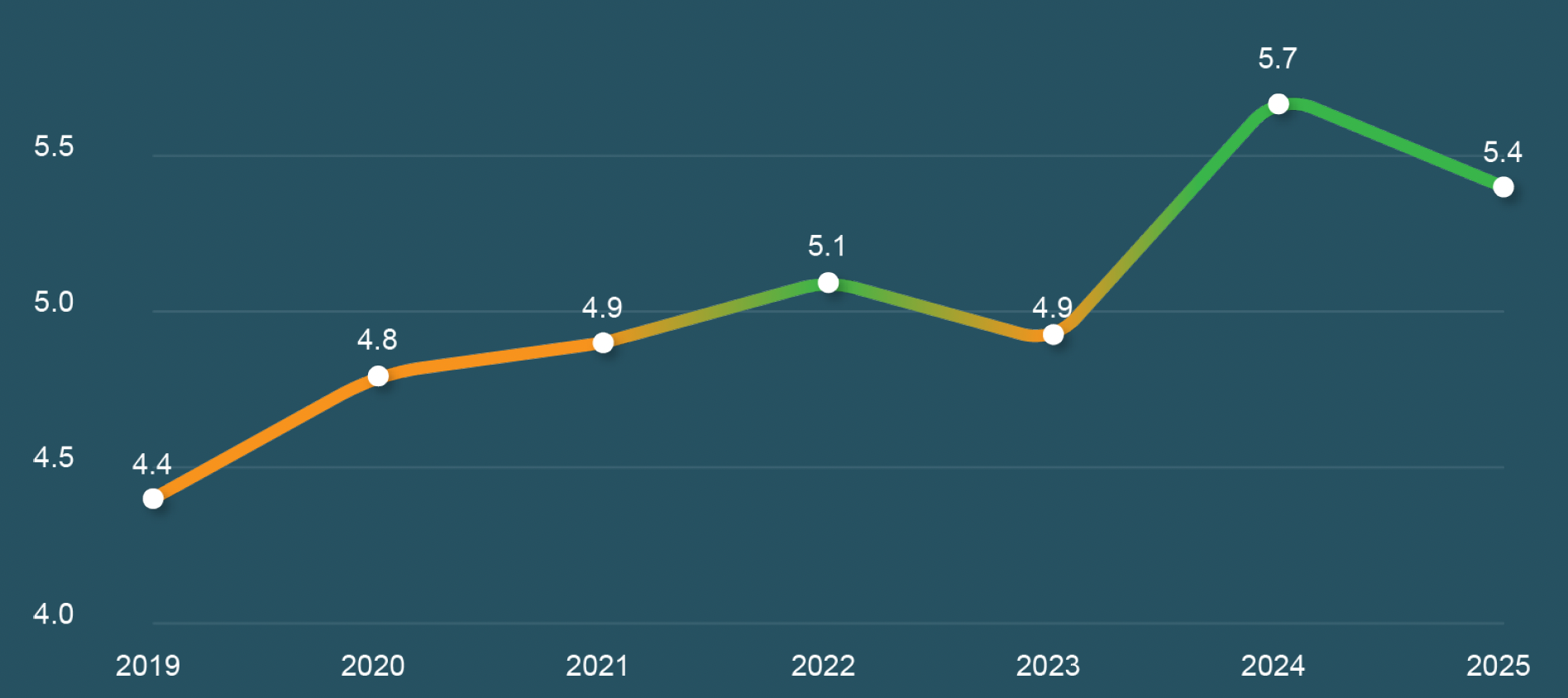
And yet, the report also reveals a less comfortable truth: the rate of change is slowing. In 2024, companies reported it took 2.2 years to see a 10% improvement in Agility maturity. In 2025, that has slowed to 3.8 years for the same 10% improvement.
That shift is not a small detail. It explains why so many organisations feel as if they are pushing and pushing, but the needle barely moves.
When progress slows, leaders often do the most logical thing: they try harder. More training. More structure. More meetings. More accountability. More reporting. And so on. But the report points again and again to a pattern: what undermines progress under pressure is not a lack of process adoption. It’s misalignment, slow governance, rigid silos, and leadership behaviour that is more about controlling.
This is the illusion of progress: lots of motion, not enough momentum. So, plenty of activity, but limited organisational movement. At surface level, it seems agile since the language and rituals are present. However, the system itself struggles to make decisions, shift authority to where value is created, and reduce friction across boundaries.
Pressure is not the problem. Unprocessed pressure is.
The report describes 2025 as a year of “trade-offs, turbulence, and tangible benefits”. That is exactly what leaders are experiencing on a daily basis: you can’t have everything. Every investment, initiative, hiring decision, or technology comes with a trade-off.
The question is not whether you are under pressure. Let me tell you, you are. There is no doubt about it. The question is what pressure does to your system.
Under pressure, organisations become more sensitive to friction. Small delays turn into bottlenecks. Slight misalignments become a political problem. Lack of clarity creates those dreaded escalation loops. Teams usually manage uncertainty well. But they begin to struggle when it becomes overwhelming. They need clarity on who makes decisions, how priorities change, and whatgood means this month.
There was one line in the 2025 report that really caught my eye: Pressure exposes the cracks in the system. I would like to add something to this: pressure does not only expose those cracks; it also widens them.
This is the area where trust can start to fade. This goes even in strong organisations with capable leaders. Not because people want to harm others, but due to constant trade-offs, reprioritisation, and a state of urgency that makes people more careful. As a result, they start to protect their scope and teams. They start asking for more certainty before committing. Hence, decision-making slows down because the fear of being wrong seems greater now.
So when leaders tell me: We are stuck, my first question is not: What is wrong with your agile implementation? It is in the domain of: Where is pressure being absorbed, and where is it being passed down? Because if pressure is passed down without translation, it turns into anxiety. And anxious organisations do not move well.
A few numbers that tell a bigger story
The report shows a key split: 59% of organisations say their rate of Business Agility is increasing, while 21% say it is decreasing.
I find that fascinating because it means progress is still possible, even under significant pressure. But it also means a meaningful share of organisations are going backwards. When under stress, systems often revert to what feels safe. This includes control, approval chains, centralised authority, and guarded communication.
The report also links Agility to outcomes in ways that are hard to ignore:
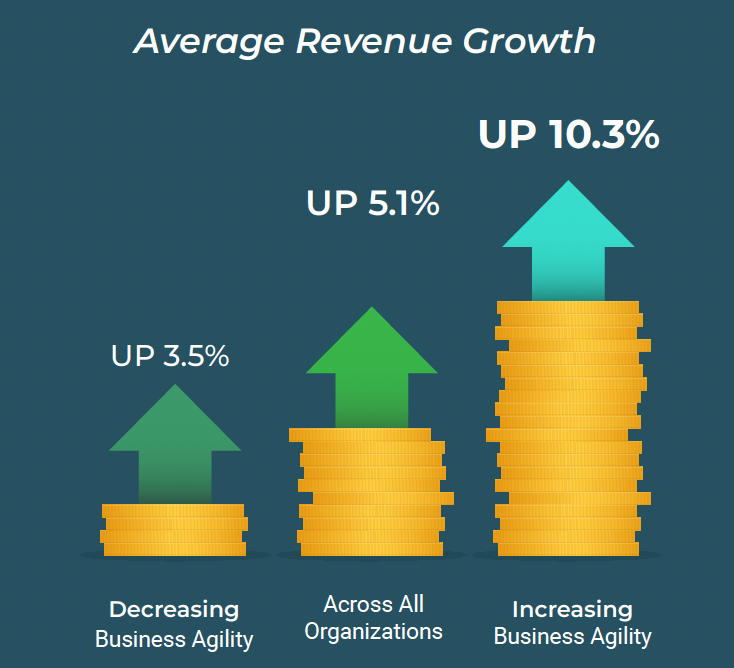
- Organisations that improved their Business Agility saw higher revenue growth in 2025. Those with increasing Agility had lifts of +5.1% and +10.3%, while those with decreasing Agility grew by +3.5% on average.
- Using Glassdoor ratings as a guide, companies with better Agility have happier employees. The Recommend to a Friend score is up 30% for agile firms, while it’s down 11% for those losing Agility. Glassdoor scores also reflect this: up 8.8% for agile companies and down 7.5% for others.
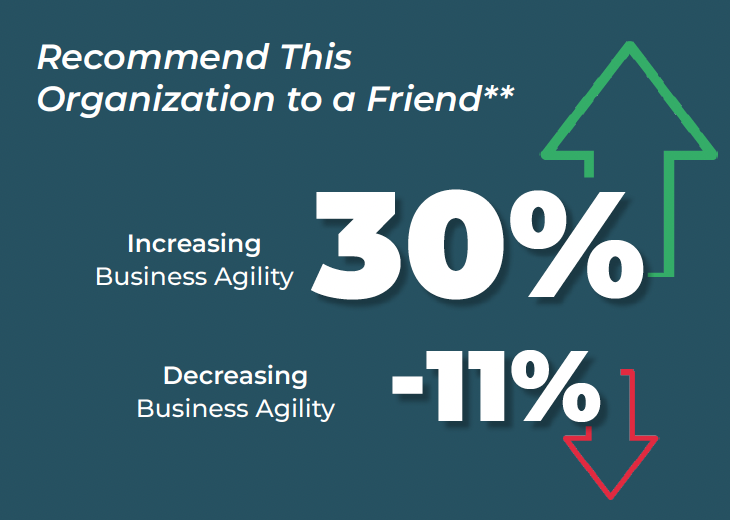
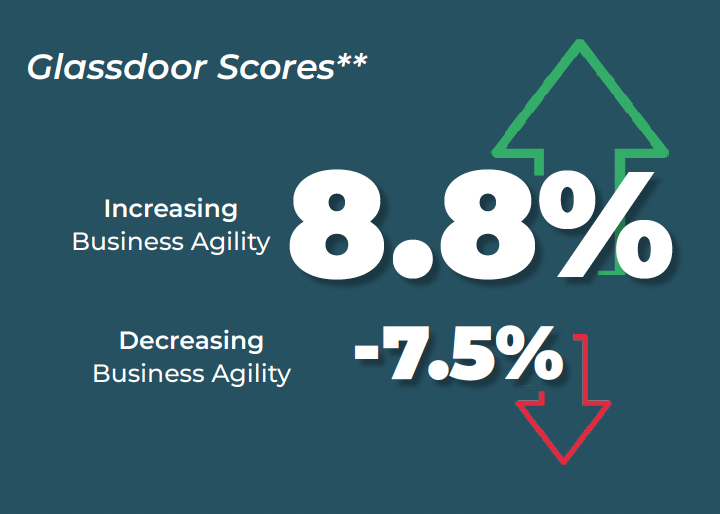
** Average since first participation in the Business Agility Report (2018 – 2024)
Now to me, these are not soft signals. They point to something leaders often underestimate: Agility is not only operational. It is also emotional. It shows up in how people inside the organisation feel. This can be all sorts of things like: proud, confident, clear, or exhausted and cynical.
The leadership trap: doing more when the system needs less
Let me name a pattern I see frequently, especially in large enterprises. When progress slows, leaders assume the organisation needs more drive. They push harder. They ask for more output. They demand faster decisions. They introduce more reporting, more governance, more alignment meetings, or more check-ins. Their intention is good: they want to protect outcomes. But the effect is usually the opposite. The system starts to clog.
The 2025 report highlights this issue: when under pressure, governance slows down, silos become rigid, and leaders shift to command and control. In other words, when leaders tighten their grip, Agility declines. Leaders often miss a key point about change: speed doesn’t come from pushing people above and beyond. Speed is created by removing friction. And friction is rarely removed by adding layers.
This is the moment organisations need a different kind of leadership strength. Not louder urgency, but steadier clarity. Not more initiatives, but fewer, sharper priorities. Not more meetings, but better decision-making authority.
The leaders I trust most are the ones who can say: We are going to slow down here, so we can speed up everywhere else.
Five steps that make progress lighter again
Now let’s seelet’s what can be done to counter organisational pressure. I want to offer five concrete steps that help organisations regain momentum under pressure. None of these are theoretical. They are all highly practical choices that reduce friction, rebuild trust, and help people in your organisation move with confidence again.
- Reduce strategic noise before you ask for more energy
When everything is a priority, nothing is anymore. Under pressure, organisations often add initiatives to signal control. But signalling is not strategy.
A move that works: cut your active portfolio. Not by lowering ambition, but by creating focus. Protect the remaining priorities from constant reshuffling. People do not burn out only from workload. They burn out from contradictory directions. When leaders create focus, teams stop second-guessing. Energy returns. - Make decision authority explicit, visible, and local where possible
Being vague or indecisive can slow down your organisation. When teams do not know who or what has made the decision, they hedge. They wait. They escalate. I have also seen them over-documenting. Or they seek permission for what should have been autonomy.
The fix is both simple and hard: clarify the decision-making process. Make it as explicit as possible and then hold to it. As you can read in the 2025 report, its basis is that Agility shows up through behaviour. Decision authority is behaviour made visible. - Redesign workflow instead of stacking more processes on top
Under pressure, organisations default to adding more processes. More approvals. More stages. More so-called quality gates or steer-co’s. But when flow slows, adding gates does not create quality. It creates more and more queues.
A better move: remove the waiting. Reduce handovers, dependencies, and the need for escalations. This is not glamorous work. It is the work that makes progress lighter. - Treat trust as a leadership practice, not a cultural ambition
Trust fades quietly under pressure. Leaders usually see this only when engagement drops significantly or talent begins to leave. The 2025 report makes the relationship between Agility and employee sentiment hard to ignore.
Trust is rebuilt through micro-behaviours like:- Explaining trade-offs, not hiding them
- Naming uncertainty, not pretending certainty
- Keeping commitments small and consistent
Involving teams early, not after decisions are made
I have often seen that trust in a company grows when leaders are predictable in a positive way.
- Build a rhythm that protects reflection, not only delivery
When pressure rises, necessary reflection is one of the first things to disappear. In my view, that is one of the most costly mistakes an organisation can make. Because without reflection, they stop learning. Without learning, they repeat friction. And so on and on it goes.
When you have a strong organisational rhythm, it protects three key elements:- Alignment: Are we still moving towards the right outcomes?
- Learning: What is the system teaching us right now?
- Decisions: What must be decided now, and by whom?
When those three are followed consistently, progress feels easier. This happens because people no longer bear uncertainty by themselves.
Can your organisation carry the accelerating AI?
The 2025 report raises a key question for leaders: does Business Agility boost AI adoption? It does show a pattern: Agility supports AI implementation when culture, structure, and leadership are robust.
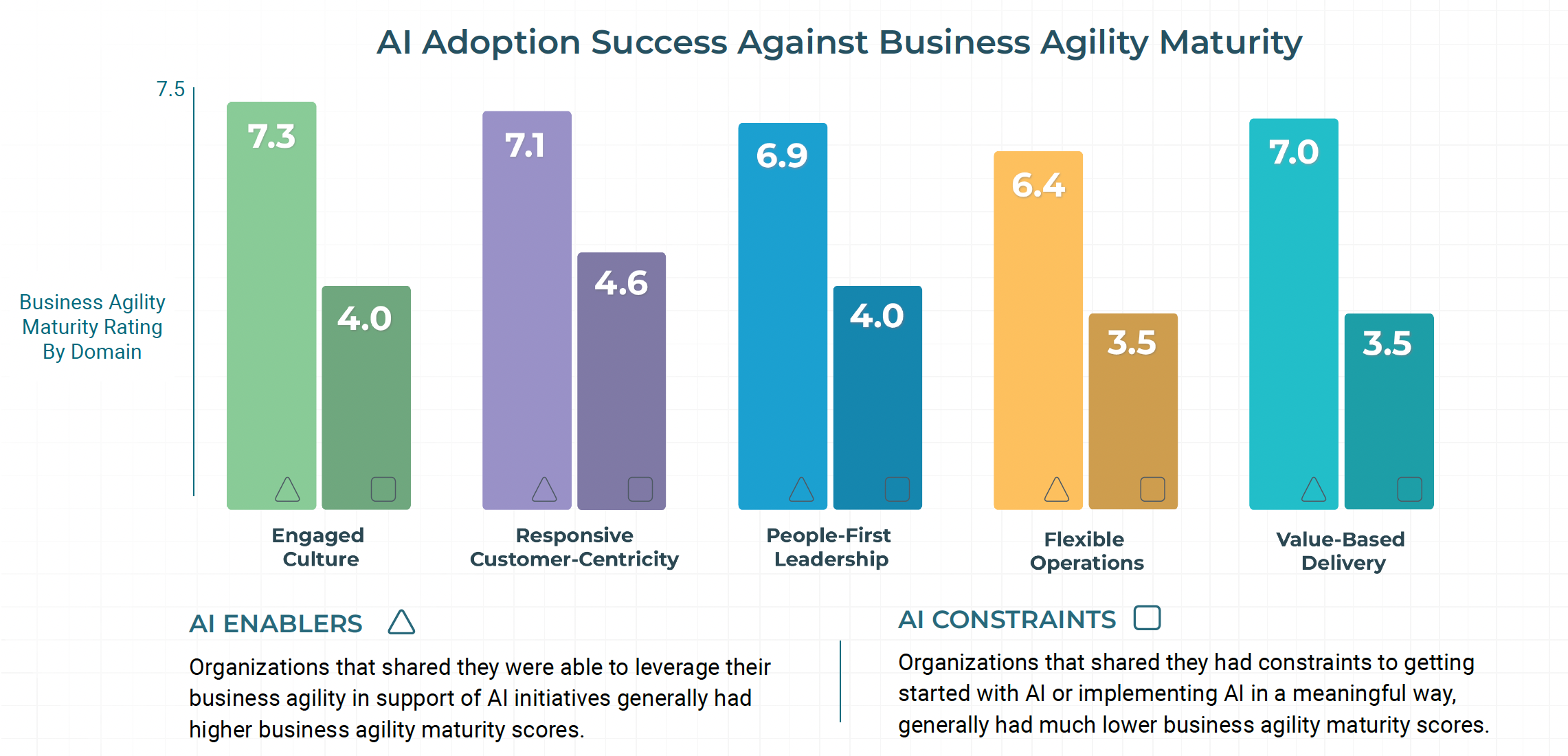
AI does not only change tools. It changes work design, decision-making, skills, and identity. If your organisation already struggles with clarity and trust, AI will even amplify those cracks. If your organisation has solid decision-making power, effective learning loops, and steady leadership, AI will act more as an accelerator rather than a threat.
This is why I keep coming back to the same point: Business Agility is not a delivery methodology. It is an organisational capability that determines whether disruption becomes a liability or a lever.
Feel the future in your current decisions
If progress seems cumbersome in your organisation right now, I don’t think the right response is to push harder. I think the right response is to get more honest about friction. So ask questions like:
- Where are decisions slowing because the process is unclear?
- Where are priorities multiplying because trade-offs are avoided?
- Where is trust leaking because pressure is not being translated?
- Where is reflection disappearing because meetings are full of status?
The 2025 report makes clear that progress under pressure is possible. But it is not achieved through willpower. It is achieved through design and behaviour. Leaders achieve this by making fewer but better choices. Organisations should stop seeing Agility as just a task. Instead, they need to treat it as a daily practice, especially during tough times.
For me, the most hopeful part of the 2025 findings is this: even with challenges, the global average remains steady, and most organisations still report growing Agility. Progress is possible. It just needs a different kind of leadership courage.
Not the courage to accelerate. The courage to simplify, clarify, and steady the system so that people can move again.
Note: If you are interested to reading the full Business Agility Report 2025, please click here. And if you want to read more on adaptive organisations, please take a moment to read one of our case studies here.

