
More organisations today speak about culture with remarkable clarity. In such organisations, leadership teams spend time defining their purpose. These teams also clarify, for instance, shared values and describe the behaviours they want to see in their company. In most of these organisations, I find that these conversations are often thoughtful and authentic. Most of the time, leaders really want to create spaces where people feel trusted. They aim to empower everyone and connect them to meaningful work. Yet, despite these intentions, culture frequently behaves in ways that surprise the very leaders who defined it.
An organisation might say it’s collaborative, but decisions can still take time to go through the hierarchy. It may, for example, celebrate openness while employees hesitate to raise those uncomfortable truths. It may even emphasise ownership while teams continue waiting for approval before acting. None of this happens because people disagree with the stated values. It happens because values alone do not shape behaviour. In practice, culture is not sustained by what organisations declare. It is sustained by what their systems consistently produce.
To me, that distinction is subtle but powerful. Values describe intention, but systems shape experience. The routines, decision-making, incentives, and leadership behaviours shape daily work. They decide if cultural goals turn into reality. When those elements align with the organisation’s values, culture becomes visible in how work unfolds. When they do not, the gap between intention and experience starts to widen.
In this newsletter, I want to explore that gap further. I will discuss why culture seldom changes through communication alone. I will also show how culture is created within organisations. And I will talk about what leaders can do to make culture a real experience for people, not just something they see.
The illusion of cultural change
When organisations try to change their culture, they often start with the aspect of communication. It often goes like this. New values are set, leadership principles are shared, and internal campaigns are started to explain what the organisation represents. This is often followed by workshops and leadership programmes, which aim to help teams internalise the new behaviours. This might be the first thing you think about as well, but there are better ways to start from.
In my experience, these initiatives often generate momentum. At least for a period of time. Conversations about culture increase. Leaders emphasise the importance of collaboration or empowerment. And employees become aware that something important is being addressed.
Yet several months into the process, organisations frequently notice that the initial energy has faded. Though values are still clear, the behaviour in the organisation has mostly gone back to how it was before. Decision-making is still moving up the hierarchy instead of reaching the teams doing the work. Meetings remain focused on reporting instead of learning. When under pressure, leaders tend to fall back on old habits instead of following new principles. Human nature is something that is not changed easily or by simply attending a workshop. It takes time and effort.
This recurring pattern is not the result of bad intentions or poor communication. The underlying challenge is that culture cannot be changed through messaging alone. Culture is not primarily a narrative problem. It is a system outcome.
Daily behaviour in an organisation depends on how:
- Decisions are made
- Accountability is shared
- Incentives are set
- Leaders act in tense situations.
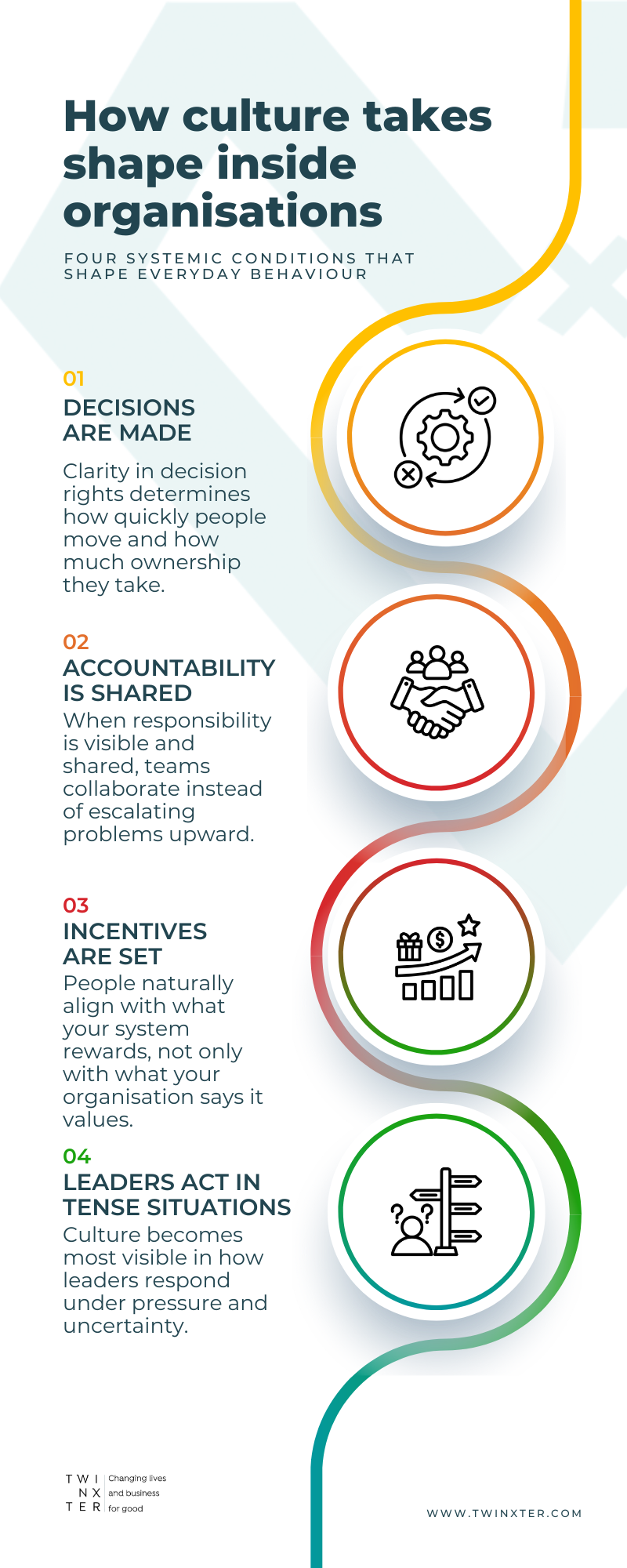
Communication can describe or show the culture that an organisation wants to build. It is the system’s design, however, that truly makes that culture last.
When the structural conditions in your organisation stay the same, behaviour patterns will eventually go back to their previous balance. The organisation can discuss new values, but the current system pulls behaviour back to what is familiar. Something I have witnessed on several occasions.
What culture actually is
To make sense of this dynamic, it helps to look at culture in more practical terms rather than symbolic ones. Culture is often seen as a shared set of beliefs or attitudes. In organisations, it takes a more visible shape. Culture becomes visible in the choices, actions, and interactions people make when they work together. Culture is the pattern of behaviour that an organisation consistently produces.
If we look more closely at how those patterns emerge, I note that they rarely appear by coincidence. Some of those forces also shape them repeatedly over time. These forces shape how people understand expectations, make decisions, and interact with each other at work.
Three of those forces shape these patterns more than anything else.
- Leadership behaviour. Employees watch leaders closely. This is especially true in tough times. What leaders reward sends a clear message. What they tolerate or correct also shows what they expect. When leaders support open dialogue, they should not get defensive about tough feedback. If they do, employees will quickly see the limits of that openness. When leaders show curiosity in tough talks, the space feels safer for them for an open discussion.
- System design. Governance structures, reporting lines, incentives, and decision rights shape behaviour in your organisation. They have a strong impact on how people act. Long approval chains and top-heavy power make employees escalate decisions. They often avoid taking ownership. When performance systems focus more on individual results than on teamwork, collaboration struggles. This happens even if your organisation claims to value teamwork.
- Interaction rhythm. The way organisations structure meetings, review progress, and reflect on outcomes shapes learning and adaptation. Organisations that create regular moments for reflection tend to identify challenges earlier and adjust more effectively. Organisations without these rhythms often discover problems only once they have already escalated.
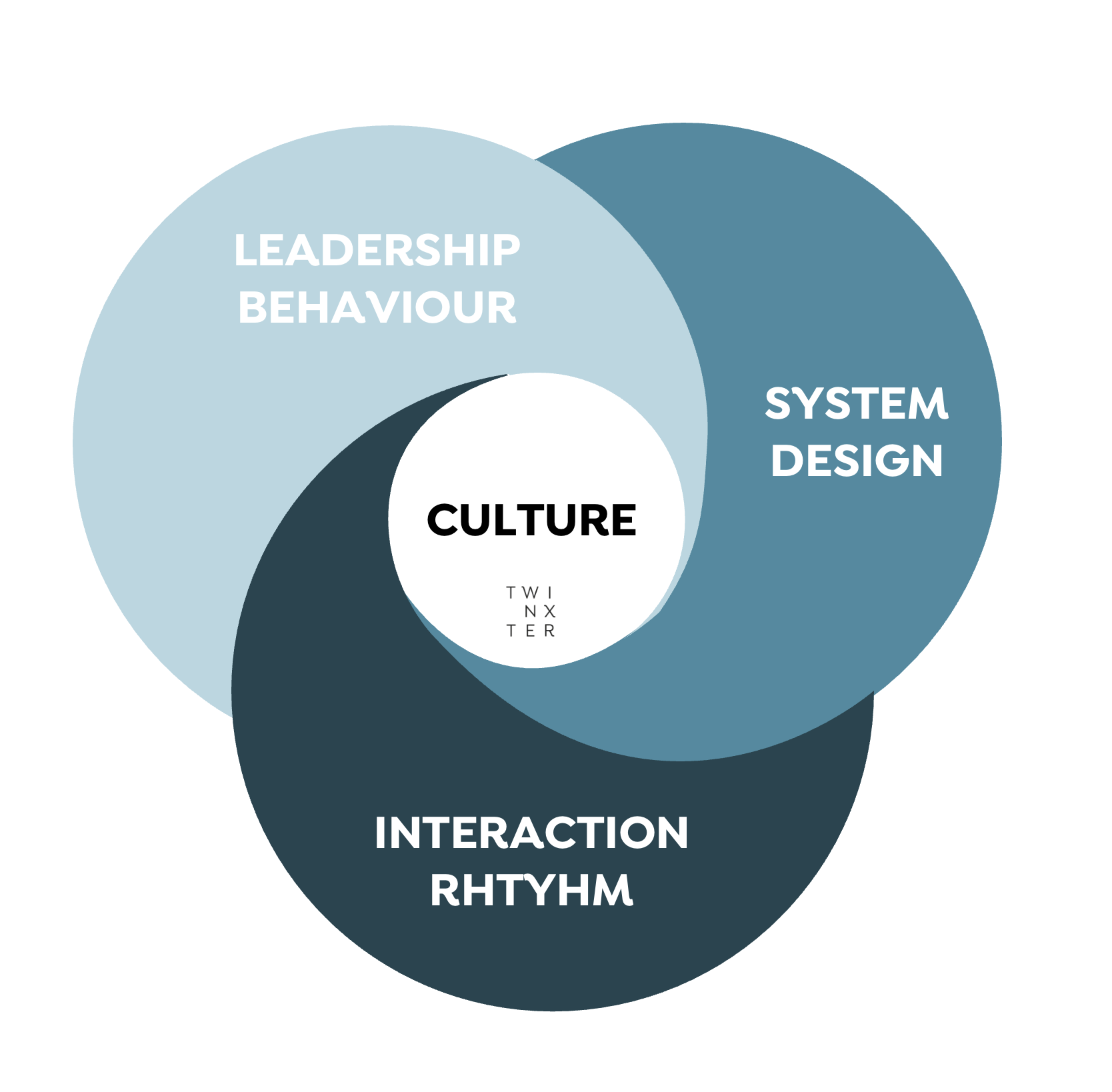
Mixed together, these elements form a sophisticated system that produces your company’s culture. When leadership behaviour, structural design, and interaction rhythms work together, culture becomes more unified. When they contradict each other, cultural friction appears. Simple, isn’t it?
Where culture is actually produced
People often talk about culture in general terms, but it is the specific moments in the daily work of people that shape it. These moments might seem routine right now, but they add up in reality. They influence how people feel about your organisation. Let’s take a closer look at five of these moments:
- Decision-making. Probably one of the most influential moments. The way decisions move through your organisation shows if teams really have ownership or if authority is still centralised. When teams are trusted to decide close to their work, they develop confidence and accountability. When decisions keep going up for approval, employees start waiting for direction instead of taking the initiative.
- Speaking up. To me, this is another critical moment. It happens when organisations encourage openness. However, employees see how leaders respond to tough issues. When concerns and different views are welcomed, people are more likely to share their thoughts. When challenging voices are discouraged, silence becomes the safer choice for most.
- Accountability is also a critical one. Clear ownership allows teams to move with purpose and clarity. When responsibility becomes blurred across layers or committees, momentum slows and frustration increases. People may work hard, yet still feel uncertain about who ultimately decides.
- Feedback loops. Organisations that review their work often become more resilient. They reflect on lessons learned and adjust their methods. This helps them grow stronger over time. Without these loops, organisations repeat patterns without recognising their consequences. In short, they are not learning.
- Leadership consistency. Leaders often build more trust during tough times than when things are smooth. In tough times, employees see if leaders are willing to learn or if they retreat into control.
Each of these moments may appear small on their own. Yet together, they are repeated by others hundreds of times each week. Over time, they form the behavioural architecture that employees experience as culture.
The systemic problem behind culture problems
I think most of you have seen how culture initiatives may struggle. Organisations often try things like changing attitudes first, while they should adjust the conditions that shape behaviour first. They encourage collaboration while keeping their incentive systems that reward individual performance. Or they keep promoting openness while preserving decision structures that discourage challenge.
In such situations, employees behave quite rationally within the environment they experience. They follow the signals that your system sends rather than the aspirations expressed in fancy culture statements.
This is why culture cannot be addressed as a separate initiative. It is inseparable from how leadership, structure, and incentives interact. When these conditions match the values leaders want to promote, culture grows stronger more naturally. When they clash, the organisation feels constant tension between goals and reality.
Recognising this dynamic often helps to shift the conversation about culture. Leaders should first ask how the system supports or blocks the behaviours they want. They shouldn’t just focus on better ways to communicate values.
What leaders can do differently
Culture comes from the conditions of your system and not just communication around it. So, leaders can shape culture more effectively by focusing on those conditions. They shape culture not just through speeches or campaigns. They do it by designing and maintaining the work environment people see every day. It is good to realise that culture follows the signals embedded in structures, decisions, and leadership behaviour. When those signals remain inconsistent, culture drifts. When they become coherent, behaviour gradually stabilises.
Leaders need to look closely at the organisational conditions. These conditions shape how work is done every day. This is key for influencing culture. Consider how decisions are shared, how progress shows up, how learning is promoted, and how leaders act under pressure. All these factors shape how people understand what is really expected. When these elements support each other, culture grows stronger on its own. It doesn’t need constant reminders to stay vibrant.
Several practical shifts can help leaders create those conditions more deliberately.
- Clarify decision rights. When it is clear who decides what, organisations move faster and teams experience greater ownership. Unclear decision authority can cause escalation, hesitation, and repeated talks. This drains energy from your system.
- Model behaviour under pressure. Leaders send the strongest cultural signals during curiosity and moments of tension. When leaders stay calm and thoughtful during tough times, trust and psychological safety grow in your organisation.
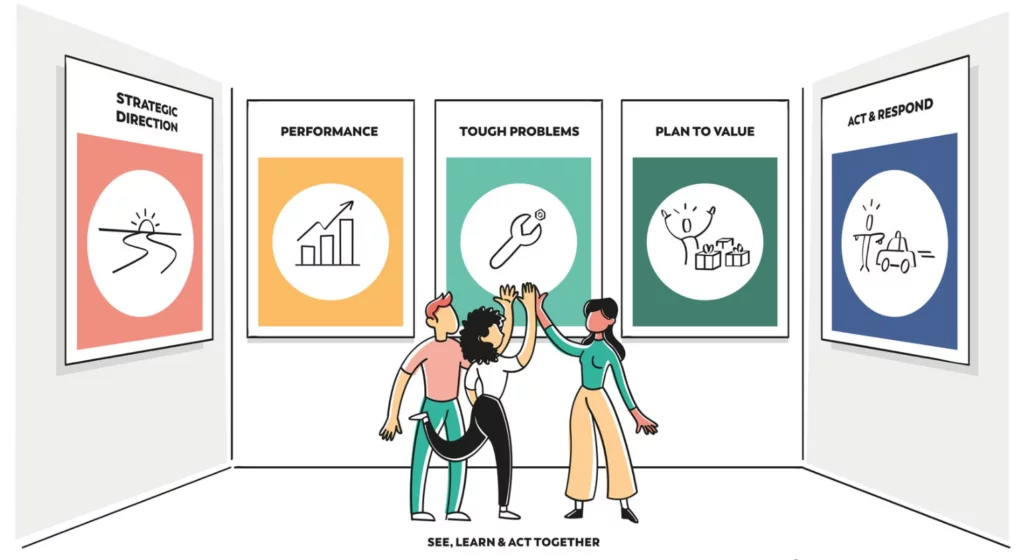
- Increase visibility. When strategy, priorities, and results are clear, alignment gets better. This makes conversations more constructive. Visual management practices, like Obeya, help organisations create a clear understanding of progress and direction.
- Align incentives with the behaviours leaders want to encourage. If collaboration is vital for success, then your rewards should focus on team results. Don’t just reward individual achievements.
- Protect learning cycles. Creating time and space to reflect on work allows your teams to adapt continuously. Without such reflection, organisations risk repeating patterns that no longer serve them.
Taken individually, these shifts may appear operational at first sight. Together, they change how people make decisions, interact, and experience leadership. Over time, these conditions begin to shape consistent behavioural patterns. When those patterns settle, culture doesn’t need to be declared. It also doesn’t need reinforcement through messaging. It becomes visible in the way your people work, decide, and collaborate every day.
When culture becomes visible
When leadership behaviour, system design, and daily interactions align, your culture starts to show in how work happens. Conversations become more open because people trust that their perspectives will be heard. Decisions move more fluidly because authority is clear. Teams feel more ownership when the system boosts their autonomy instead of limiting it.
In such environments, culture no longer needs to be reinforced through slogans or reminders. It emerges naturally through the patterns of interaction that your people experience every day. And this is precisely the moment when culture stops being a value statement and becomes a living system.
When culture becomes visible
Culture does not change simply because leaders describe it more clearly. It changes when your organisational system begins to produce the behaviours that leaders want to see.
Designing those conditions requires attention to governance, incentives, decision rights, and leadership behaviour. It might not sound as fancy as launching a culture campaign, yet it is far more powerful. Once your system begins reinforcing the desired patterns consistently, your culture sustains itself.
If this topic reflects challenges in your organisation, you can learn more about our approach at twinxter.com. Conversations about culture usually start with values. They become meaningful when we look at the systems that shape those values daily.

