
In many organisations, there comes a time when pressure doesn’t flow smoothly anymore. Instead, it starts to build up in the middle. The pressure does not stay with senior leadership, where much of the strategic ambiguity begins. It does not stay at team level either, where the daily impact is felt most directly. Instead, it settles with managers, who end up absorbing far more than their role was ever meant to hold.
I guess most of us are familiar with it and that is the pattern I want to explore in this newsletter. Not managers as a job title, but managers as the layer that absorbs unresolved pressure from every direction. These managers face changing priorities from above, uncertainty from an upcoming change, emotional strain from their teams, and pressure from the work itself. They are indeed in quite a pickle these days. Over time, their role has changed significantly. A manager now does more than guide people and move work from A to B. They act as a buffer for all the issues the organisation hasn’t solved elsewhere.
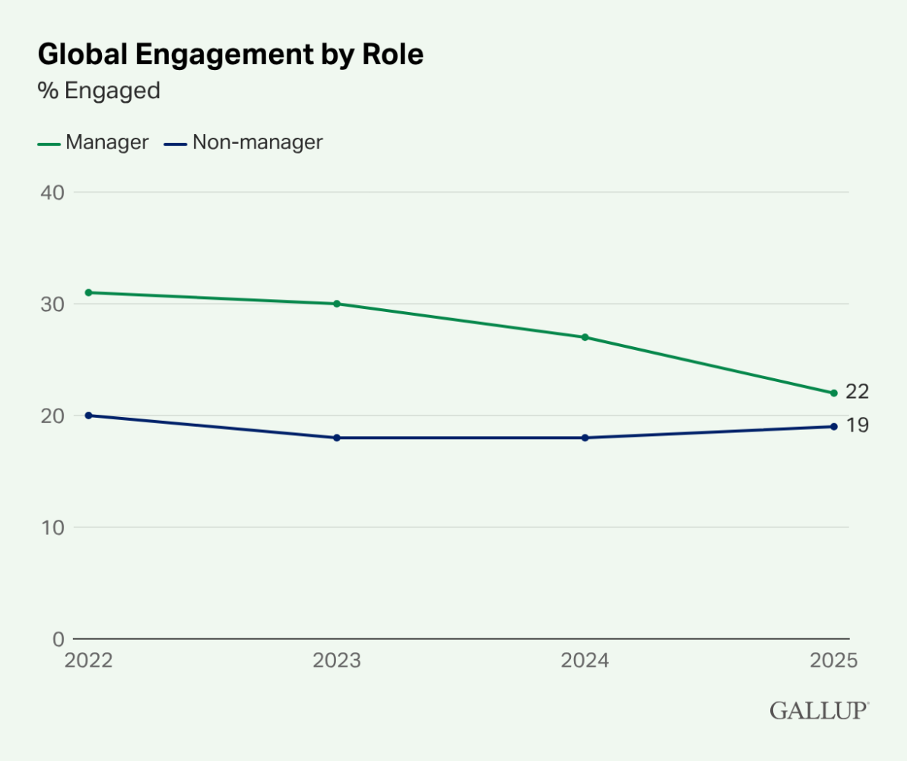
Gallup’s latest workplace data gives this real weight. Global employee engagement dropped 1 point to 20% in 2025, while manager engagement dropped 5 points to 22%. Gallup also says that the drop in manager engagement explains most of the recent decline in employee engagement(Gallup, 2026). And that certainly matters because when managers start running out of room, the effects do not stay with them. The whole organisation feels it.
The role has changed
Most organisations still speak about managers as if the role is largely stable. There is a team to support, performance to guide, and priorities to deliver. But in reality, the role has become far more complex than that. Managers are expected to turn strategy into daily tasks. They must manage the human side of change, keep teams on the same page, and have performance discussions. They also need to support their teams, stay focused on delivery, and often stay productive themselves.
That would already be demanding on its own. At least to me, it would. It becomes even harder when the structure around the role keeps stretching at the same time. In the same report, Gallup notes that the average number of direct reports per manager in the U.S. went up from 10.9 in 2024 to 12.1 in 2025. This is nearly a whopping 50% increase since Gallup began measuring span of control in 2013. (Gallup, 2026).
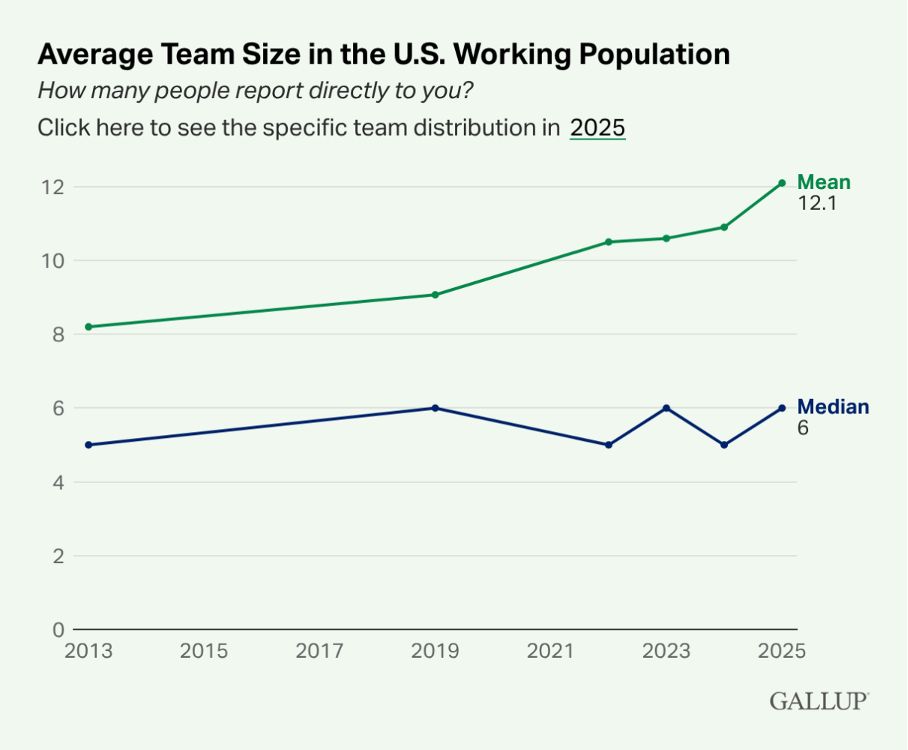
What that means in practice is easy to miss. It is not simply that managers have more people. It is that they have less space to manoeuvre in. Less space to notice what is going on in their teams. Less space to coach. Less space to catch problems early. And less space to translate complexity into something people can actually work with.
Pressure rarely stays where it starts
This is one of the reasons I think the manager layer is so often misunderstood. The visible problem may sit elsewhere, but pressure usually goes straight down the middle.
Your company’s strategy might still be unclear, but managers already have to translate it. Priorities keep changing, so managers re-explain them. Teams are overloaded, so managers absorb the frustration. Leaders want more ownership, but decision-making is still slow. As a result, managers feel both sides: the pressure and the disappointment. None of this tends to show up neatly in an org chart. It does, however, shape daily work more than many formal structures do.
That is why managers so often become shock absorbers. They take in unclarity, contradiction, uncertainty, and other pressures that the wider system has not yet resolved. They soften it, reinterpret it, or keep it long enough with them to keep their teams moving. From the outside, this can look like leadership. Unfortunately, most of the time it is not. In reality, it is often unmanaged pressure, held together by human effort.
What this starts to do to teams
The impact is not always obvious at first. Teams do not suddenly stop functioning because managers are overstretched. The signs are more subtle than that. Conversations become more superficial. Feedback gets delayed. Decisions take longer to land. Escalation increases. And managers become more reactive because they no longer have got enough space to stay ahead of the game.
That shift matters. It really does. When managers run out of space, teams often lose one of their most important sources of coherence. The person who normally helps make sense of the mixed messages, absorbs uncertainty without making it even bigger, and creates some rhythm in the middle of pressure no longer has enough capacity to do that well. Things start to tumble down.
This is one reason Gallup’s manager engagement data matters more than it may first appear. If manager engagement is dropping faster than employee engagement, it is not just a signal about one role group having a hard year. It is a sign that one of the organisation’s core stabilising layers is carrying more pressure than it can process (Gallup, 2026).
Hidden inside normal work
What makes this difficult is that very little of it looks dramatic on the surface. Much of the pressure is hidden inside what organisations have started treating as normal. More updates. More reporting. More one-to-ones. More change communication. More cross-functional alignment. More requests for visibility. More emotional availability. More employee-coach work on top of all of it.
Gallup’s research helps here too. It found that 97% of managers still do individual contributor work. Also, managers spend a median of 40% of their time on these tasks. That means many managers are not only carrying their teams, they are also expected to keep producing as contributors while doing so. (Gallup, 2026).
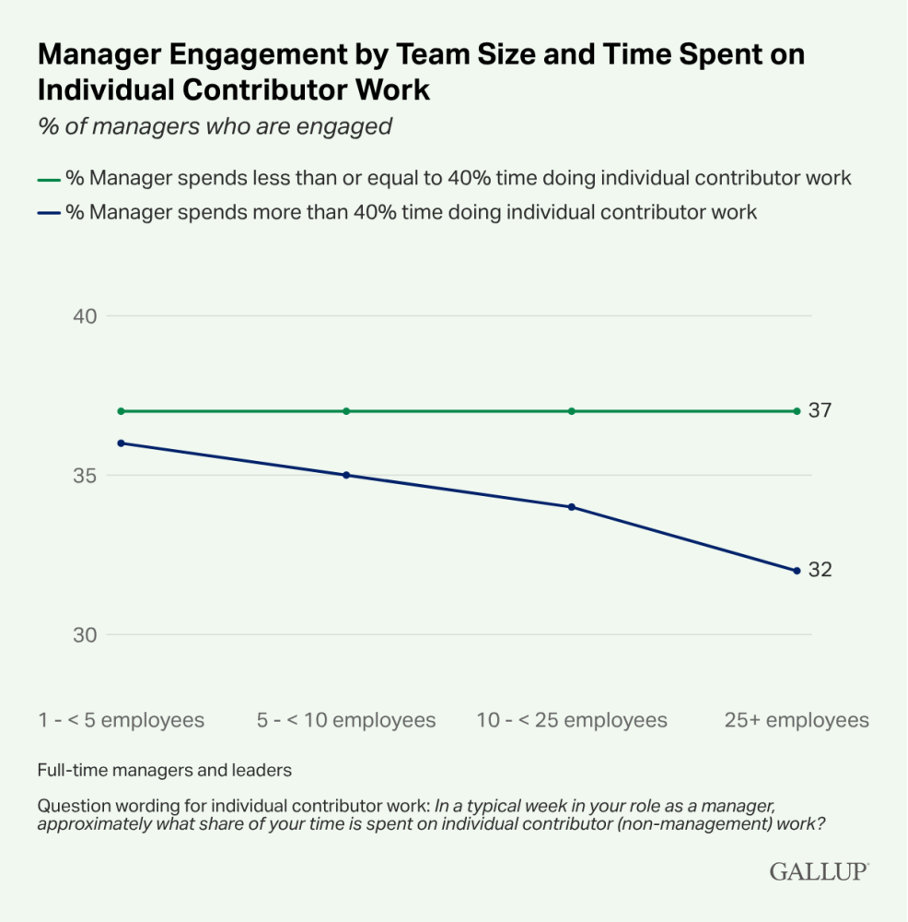
This is where the role starts to become impossible in many ways. Not because managers are weak, and not because they are not trying hard enough. Organisations keep adding more workload but do not make serious choices about what to remove, clarify, or redistribute.
Why this matters more than it seems
It would be easy to read this as a management workload issue and stop there. But I think something deeper is going on.
When managers start to act as shock absorbers, organisations start to rely on people’s ability to adapt instead of providing clear structures. Managers manually hold together what purpose should have aligned. They manually absorb what clearer priorities should have reduced. They manually soften what better decision-making should have prevented. They even manually carry the emotional aftermath of choices that were made elsewhere.
In my practice at Twinxter, I see this often in organisations that are full of good people and serious intent. They want stronger leadership, more ownership, and healthier teams. But they don’t see how much pressure has shifted to the middle. Over time, that middle layer becomes less able to guide and more occupied with buffering to keep it all going. That is when movement begins to stall.
Four signs your managers are absorbing too much
This kind of pressure does not always announce itself very clearly. More often, it builds gradually and becomes visible through small shifts in behaviour, tone, and rhythm. Managers might seem committed, responsive, and involved. But underneath, they often carry more unresolved pressure than they can handle for long. That is why the warning signs are easy to miss at first.
Some patterns often repeat when managers lead too closely and take on unresolved issues from the organisation.
- Managers keep translating what should already be clear. When direction, priorities, or decisions need constant reinterpretation, managers become the manual processing layer for your organisation. They are not only leading people, they are continuously trying to make the system understandable.
- Pressure arrives faster than support. Managers feel the frustration, uncertainty, and overload in real time. But they often lack the authority, clarity, or space to tackle the root causes. So they keep the emotional pressure alive without being able to resolve much of the source.
- Coaching gets replaced by firefighting. Most managers care deeply about their people, but their daily reality shifts. Less development, less reflection, less meaningful feedback, and more short-term coordination. Gallup found, for example, that meaningful weekly feedback is strongly associated with engagement. Yet this is something that remains uncommon in most organisations (Gallup, 2026).
- Managers start protecting the system from the team, and the team from the system. This is often the clearest sign. Managers filter messages, ease decisions, handle frustration, and keep things on track with their personal effort. It can look admirable, but it is also a warning that too much unresolved strain is being carried by one layer.
When you see several of these signs at once, try not to think of them as separate flaws. More often, they point to a role that has become overloaded by invisible work. That is exactly what makes this issue so important. The manager isn’t just leading the team anymore. They are also handling issues that the wider organisation hasn’t sorted out on its own.
What helps managers avoid taking on too much
If this pattern is showing up, the answer is not to ask managers to become even stronger. That only reinforces the very dynamic that created the problem. The better move is to reduce the amount of unresolved pressure that has to be absorbed in the first place.
A few shifts help.
- Make strategic direction less ambiguous. The more managers have to translate what leaders have not made clear, the less room they have left to lead well.
- Reduce escalation where it is not needed. Managers are expected to build ownership while most meaningful calls still travel upwards. This way, they end up stuck between expectation and authority.
- Protect rhythm. Not everything needs to move at once, and not every issue arrives in the same week with the same urgency. Rhythm is important. It allows the middle layer to support movement rather than just reacting to collisions.
- Create space for meaningful feedback and development. Gallup’s findings on weekly feedback are very clear and useful. They show that engagement is not sustained by slogans or annual reviews. It is sustained by the quality of regular managerial contact (Gallup, 2026).
What matters in all of this is that none of these shifts ask managers to become superhuman. They ask the organisation to stop making the role carry more than it should. When direction is clear, decisions happen more smoothly. Rhythm takes over constant urgency, and space for feedback is valued. This way, managers are less likely to act as shock absorbers for the entire system. That is when the role starts to feel like leadership again, rather than like permanent strain management.
The question underneath it all
The deeper question is not whether managers need to become more resilient. It’s about whether the organisation has made them responsible for handling issues it hasn’t resolved properly elsewhere.
That is what makes this worth paying attention to. When managers act as shock absorbers in your organisation, teams can keep going for a bit. However, they rely on support that is overloaded with unseen pressure. That strain eventually appears in many areas: slower decisions, thinner conversations, weaker engagement, and more challenging changes.
If this sounds familiar, than that is often a useful signal in itself. It usually means the talk should shift from just manager skills to the quality of what managers are expected to handle. That is where the more meaningful shifts tend to begin.
If you want to explore this further, my work at Twinxter can help. It focuses on creating clarity, improving rhythm, and finding better ways to manage change without overwhelming the middle.
If these insights have helped you see your organisation more clearly, and you want to explore what that could mean in practice, let’s have that conversation. Book a 30-minute call for an honest exchange about where leadership is working well, and where your design may be getting in the way.
Book your complementary call here https://www.twinxter.com/contact/

