
One of the easiest things to underestimate in your organisation is clarity. The thing with clarity rarely is that it seldom starts with the same energy as your ambition does. It is not something that is as shiny as a new transformation plan, growth targets, or your new priorities. And yet the moment clarity in your company starts to slip away, that is exactly the moment your organisation will start to feel it. You can look for signs like meetings that multiply, decisions that start to slow down, or teams that work hard but not always in the same direction. What you can also see is that people will start to fill in those gaps with assumptions. And before you know it, what seemed like an execution issue turns out to be something different.
That is why I want to make the case that clarity is not a soft topic, and certainly not just a communication topic. In many organisations I support, clarity is becoming a real competitive advantage. Not because it makes work easier, but because it helps people handle complexity with less friction, less duplication, and less wasted energy. Curious to understand how? Read on!
Under pressure, clarity erodes
When your organisation experiences pressure, it most likely responds with more movement. More updates. More meetings. More initiatives. More communication. And yes, at first glance, that can feel responsible and even good. Leaders try to reduce uncertainty, create momentum, and keep people informed. Sounds all right, doesn’t it? But in practice, that same response often causes the opposite effect you are looking for.
Clarity is usually one of the first things to erode pretty quickly when priorities multiply faster than people can absorb them. The same occurs when leadership teams think they broadly agree, but still have different underlying opinions. What you then find is that things like internal ownership become blurred. Or decision rights become unclear, and people spend more time trying to work out the priorities than actually moving them forward.
This is one reason why unclear organisations do not always look unclear from the top. On paper, everything may still seem fine. Your strategy is there. Your priorities are written down and distributed. The communication plan is in place. Everything is the way it should be. But lived clarity inside your company is something else. It depends on whether your people can see what is of importance right now. They need to know what they’re expected to do, what trade-offs are real, and how their work fits into the bigger picture. That part is crucial.
Clarity shapes performance
I experience that many organisations still believe clarity can be managed by communication style, tone of voice, or employee preference. But that is a far too narrow perspective. Clarity helps people act quickly. It boosts their confidence and sense of ownership. Plus, it reduces the energy wasted on coordination.
When clarity is something that is not a strong feature in your company, it does not mean that every effort is lost. It does, however, get diverted. Your teams still work hard. However, they now spend more time on interpretation, alignment meetings, status checks, and local guesswork. This has the effect that managers function as a buffer for unclear messages. The same message gets explained more than once from different angles. Different teams make different trade-offs from the same strategy. And what leaders often interpret as hesitation is sometimes nothing more than people trying to act without enough usable direction.
That is why I see clarity as a performance condition. It does not replace capability, but it determines how well that same capability can be used. People can only move forward when they know what’s important, where and what they can decide, and what kind of progress is expected.
What an unclear organisation feels like
First things first. An unclear organisation does not always feel chaotic. More often, it feels tiring. I’m sure you know the feeling. People are busy, but not always that confident. Teams are moving, but not always with the same understanding of the priorities. Managers are explaining the same things more than once. And senior leaders grow frustrated when they see that priorities have already been communicated. Yet, people are still trying to figure out what has changed and what has not.
That is where I see a recognisable pattern that tends to appear. When more energy goes into coordination, more issues are escalated. As a result, the number of meetings increases to address gaps that shouldn’t have existed in the first place. Managers start to spend more time translating mixed messages and stitching everything together. Teams rely more and more on interpretation than on shared direction.
This also shows the clear relationship between clarity and trust. If your message says focus, but everything still feels urgent, people will stop trusting your message. If your strategy values ownership, but decisions keep getting escalated, people will stop trusting that structure. If leaders say their priorities are clear, but teams hear various views on success, trust in that proclaimed clarity will soon disappear.
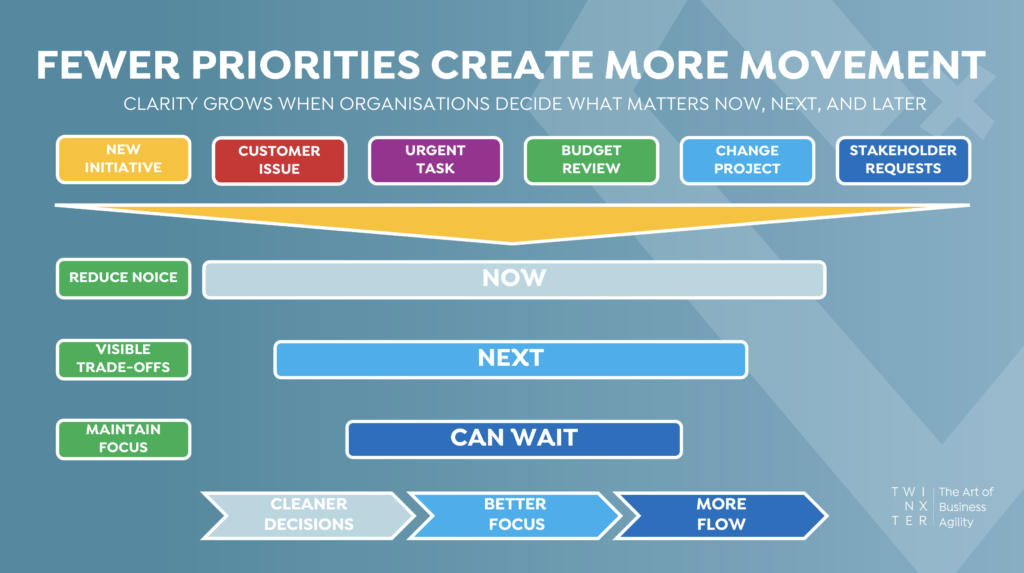
Fewer priorities create more movement
One of the most common mistakes I see is the belief that progress comes from keeping more things in motion. In reality, the opposite is often true. As more priorities compete for attention, it gets harder for people to decide what to do now, what can wait, and what trade-offs they can make.
This is where clarity and discipline become closely connected. Clearer organisations tend to make fewer things urgent at the same time. They also do not try to communicate everything at the same time with equal importance. And quite notably, they do not ask every initiative to be treated as if it were critical. They are simply put more willing to decide what is important now, what is important later, and what simply does not need attention yet.
That is why clarity is not about oversimplifying reality. It is about making your deliberate choices visible. What matters now, what matters less, what can wait, what trade-offs can be made, and what actions are expected from people. Once those things are clearer, your organisation feels lighter, even if your ecosystem is still complex.
What clearer organisations do differently
Clearer organisations do not necessarily communicate more. Really, they don’t. What they actually do is communicate more usefully. They do not assume that because something has been said, it has also been understood. They make priorities visible, not just available. They create explicit trade-offs instead of leaving people to figure them out themselves. They clarify who decides what, so ownership becomes more than a slogan on your shiny wall. And they create a company rhythm where people can see how direction is turning into action over time.
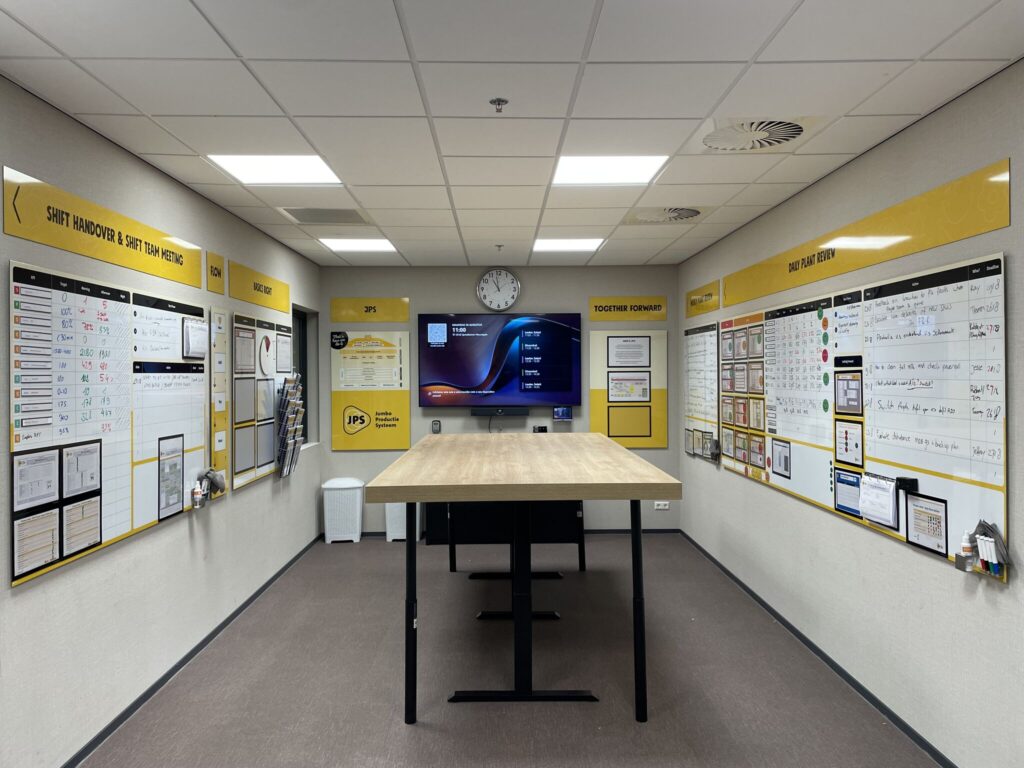
This is one reason I keep coming back to visibility and cadence. When your priorities, blockers, decisions, risks, and progress are clear in one shared rhythm, clarity is less dependent on interpretation. That is also where Obeya comes in. At its best, Obeya is not just a fancy room or wall. It is a behavioural discipline that helps people work from the same reality. It helps you and others see what’s important. You can easily identify where movement is blocked, what needs a decision, and where different parts of your organisation are drifting apart.
Leadership behaviour is equally important. If your message says focus, but your behaviour still rewards overload, rest assured, people will follow your behaviour. If your message is about trust, but your daily actions lead to defensiveness and escalation, then trust won’t grow. If the message says ownership, but real decisions remain vague or delayed, clarity will not hold for long. Clearer organisations reinforce clarity structurally, visually, and behaviourally.
Leadership behaviour is equally important because clarity is reinforced in what leaders do, not only in what they say. When leaders show trade-offs, keep a steady pace, and act on what’s important, people better understand their position. When decisions stay vague or priorities keep shifting, clarity starts to erode again. That is why clearer organisations do not rely on messaging alone. They support clarity structurally, visually, and behaviourally, until people can see it back in daily work.
What this looks like in practice
If you take clarity seriously, then you have to treat it as something that is built into your organisation, not just explained to it. That means try to make priorities easier to see, trade-offs easier to understand, and decision-making easier to follow. In my own work, I would usually translate that into a few practical shifts:
- Reduce competing priorities. Not everything can be urgent at the same time. Clarity grows when people can see what matters now, what matters later, and what simply does not belong on today’s list.
- Make trade-offs visible. Too many organisations keep the real choices hidden inside leadership conversations. People move better when the trade-offs are explicit, not assumed.
- Clarify decision rights. Teams need to know how they can act, where alignment is needed, and when escalation is actually useful.
- Create one shared rhythm. A steady focus on priorities, blockers, decisions, risks, and progress helps everyone share the same view of reality.
- Use Obeya as a living system. Don’t use Obeya just as a reporting theatre. Use it as a place where leaders, managers, and teams can see the same work, spot gaps earlier, and make better decisions together.
None of this removes complexity. But it does stop complexity from turning so easily into confusion.
And that is where clarity starts to become your competitive advantage. Not so much because your organisation becomes less ambitious. It’s nothing like that. It is because your ambition is supported by sharper focus, cleaner choices, and better line of sight into what really important.
The real advantage
This is why I think clarity is becoming a competitive advantage. Not because organisations with clarity are magically less complex. They are not. But because they waste less energy fighting unnecessary confusion. They spend less time reinterpreting intent. They make better trade-offs earlier. They free managers of the burden of carrying out the extensive translation work of your mixed messages. And they help teams move with more confidence and less rework.
Even recent work from Gallup highlights clarity as a key factor that boosts engagement and effectiveness. That fits nicely into what I see in organisations: when people lose sight of their goals, performance slips more rapidly than effort does.
So if your organisation is under pressure as well, it may be worth asking some tough questions. Are people indeed putting enough effort into it? But also, do they have the clarity needed to make that effort effective?
That is where the real advantage begins. And if you want to explore that more deliberately, this is also where my work at Twinxter can help. Especially when the challenge is not just setting direction. It’s also about making priorities, decisions, and progress clear enough for people to follow.
If these insights have helped you see your organisation more clearly, and you want to explore what that could mean in practice, let’s have that conversation. Book a 30-minute call for an honest exchange about where leadership is working well, and where your design may be getting in the way.
Book your complementary call here https://www.twinxter.com/contact/

