
Is it possible for an organisation to look aligned from the top and feel very different everywhere else?
Maybe you have experienced this as well. In your boardroom, your new strategy makes sense. Your priorities have been set and seem clear. Your aspired change is moving and the necessary progress is being reported. Even your dashboards are reassuring that everything is hunky-dory. It makes you feel that your teams are on a roll.
Meanwhile, in the heart of your organisation, managers turn change messages into clear priorities. Their teams are working hard, but maybe not always with the same understanding of what is really important. People are adjusting to the desired change, but not everyone feels as confident as you might think. And at the front line, your organisation may feel far less coherent than it looks on that same strategy paper you created.
That is the gap I want to discuss in this newsletter. And not because organisations should expect everyone to see things in exactly the same way. They really should not. But because the gap between what leaders describe and what people actually experience is often much larger than most senior teams understand. And you know what? When that distance grows, alignment breaks long before the actual execution does.
The problem starts before execution does
One of the reasons this topic matters so much is that it is easy to misread the signs. When your execution is starting to slow down, leaders tend to look first at delivery, discipline, or capability. They think as in: Are people focused enough? Are teams moving quickly enough? Is ownership sitting in the right place? And yes, those are fair questions, but they do not always get to the heart of the issue. Sometimes, the bigger issue is that people don’t see the organisation the same way as leadership does.
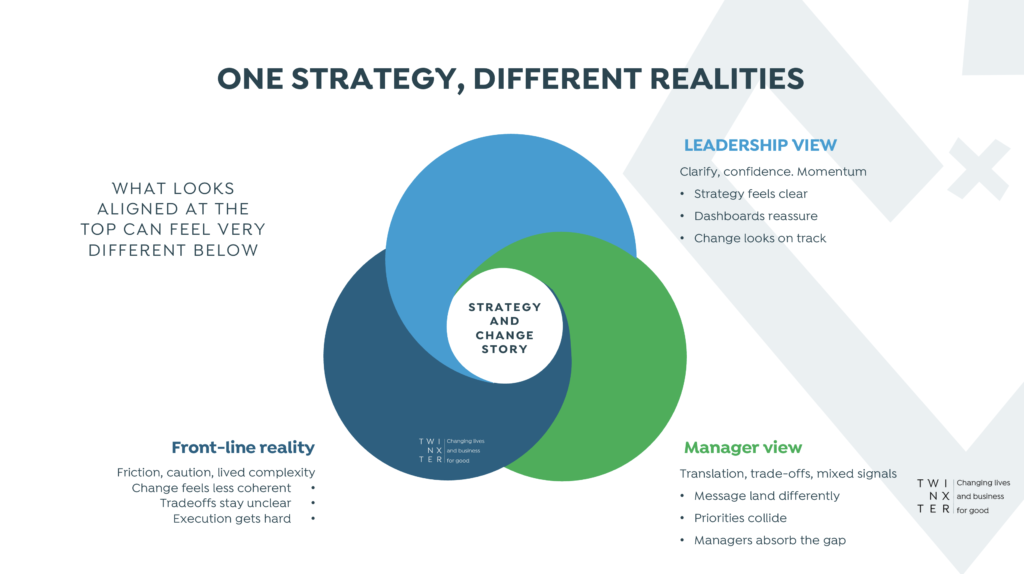
From the top, the sky is sunny and your strategy may feel clear. From the middle, clouds are popping up and it may already feel quite mixed. From the front line, the sun is difficult to see and any strategy may feel distant or hard to connect to daily work. The result is that leaders think they’re tackling an execution challenge. At the same time, employees face a struggle for meaning and clarity.
That distinction is really important to understand. Because if the issue is not only about execution, then more pressure on execution will not solve it. In some cases, it will widen the gap further.
The data is real
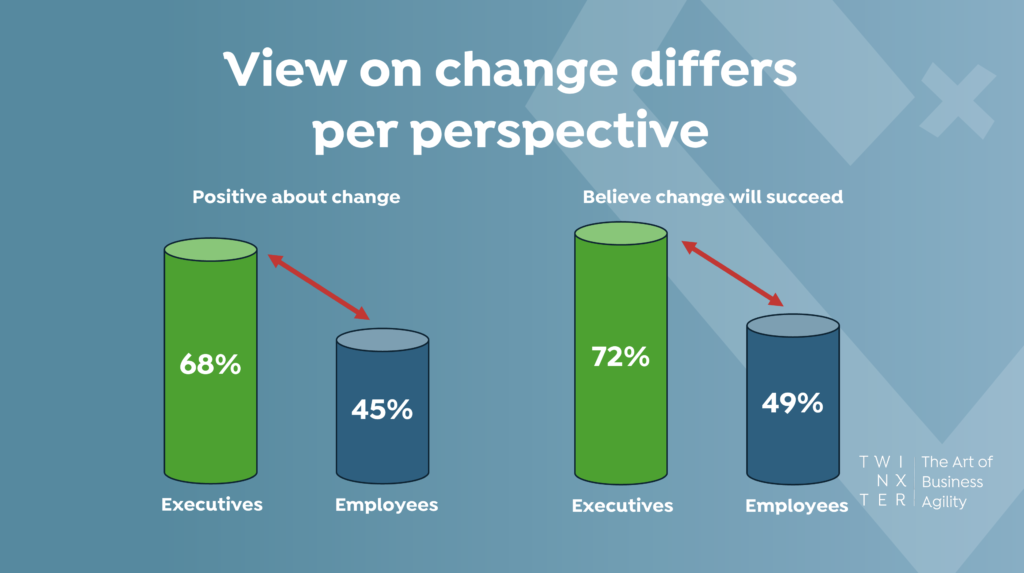
Let’s first take a look at some of the data out there. There is now strong evidence that leaders and employees often experience change very differently. BCG’s 2026 transformation research is especially useful here. It found that 68% of executives feel positive about a change before they have even heard the details, compared with only 45% of employees. When asked whether a change is likely to succeed, 72% of leaders said yes, while only 49% of employees shared that same confidence.
To me, that points to something deeper than just some issues around your communication style. They suggest that people are often not sharing your same organisational reality when they look at the same initiative. Your official story may be one of momentum and opportunity. The lived experience is however much more careful, uncertain, or even fragmented.
When we look at Gallup’s most recent workplace data, they point in a similar direction. Global employee engagement fell again in 2025, and Gallup also warned that role clarity is further eroding. And when organisations are in flux, clarity becomes more important. If people lack clarity, consistency, or trust about your change, even good strategies can feel shaky in practice.
And finally there is McKinsey’s 2026 work on skills in Europe. This shows that leaders and employees are not always prioritising the same future capabilities. Leaders usually focus more on tech skills. In contrast, employees often value socio-emotional abilities more. It’s another sign that different parts of your organisation may already be preparing for different futures. Starting to get worried yet?
Why leaders miss it
It would be good to realise that this gap often isn’t due to careless leaders or uncommitted employees. In most cases, it emerges because organisations have numerous screening processes. Signals get softened on the way up. As discussed in my previous article When Manager Become Shock-Absorbers, managers translate, absorb, and protect. Company dashboards summarise complex matters into cleaner summaries. And believe me, I’ve sat in enough meetings that value progress language more than the real challenges people face. This way, senior teams hear about the progress made, but not always about the challenges that still need to be addressed.
Then there is the problem of false alignment. Leadership teams may think they are aligned if they agree on broad ideas. But they may see the strategy differently. They might disagree on what should change first and where the real risks lie. When those differences get to the rest of the organisation, they often come across as mixed messages, unclear decisions, and competing views. Not something you want to aim for.
That is one reason the gap between strategy and lived reality can widen so quickly. The official view of your organisation can be much cleaner in presentation decks than your people actually experience it. In such a case, the story that unfolds becomes more coherent at the top than it feels below.
Managers are in the front line
Middle management tends to see this gap before anyone else. Managers are usually the first to notice when the message sounds clear in theory but lands differently with their teams. They experience where priorities collide. They see where people get confused about trade-offs. They notice when communication sounds nice and polished but leaves too much room for interpretation. Senior leaders think things are clear, but teams feel pressure. They’re still figuring out what has actually changed.
That is why managers matter so much in this conversation. Managers are often the place where the company line meets daily reality. If the gap is small, they can help translate it productively. If the gap becomes too wide, they take on too much of the difference themselves. They spend a lot of time figuring out changes by hand. They clarify things that should have been clearer and shield people from contradictions that should have been sorted out sooner. That is one of the reasons alignment can appear stronger than it really is for longer than it should.
Execution starts to suffer
This is also the point where leaders can misinterpret what is happening. When your organisation starts slowing down, it may look like a delivery issue. You notice things like hesitant teams, slow decisions, weak ownership, or shaky momentum. But often, these are later effects of something that happened before. People aren’t responding to your shared version of reality anymore.
And here is where your execution starts to weaken in subtle ways first. Maybe you recognise the following as well. Trade-offs become inconsistent. Teams interpret the strategy differently than you expect them to. The same message gets translated into different actions. Energy gets spread across too many priorities. People complain about the increasing number of meetings. Though progress is still being made, it is with a lot more friction, more rework, and more dependencies on varied interpretations.
At this point, execution does not fail because people do not care. It breaks down when your organisation’s real experience doesn’t match what leadership thinks.
What helps close the distance
The answer is not simply more communication. In fact, sometimes more communication can make things worse. If it increases noise instead of understanding, the problem can grow even further.
What helps is making your strategy more visible, more open to discussion, and more connected to real work. People need to see and understand why it matters now and not only hear what matters in principle. They look for clear priorities, specific trade-offs, and a decision rhythm. This helps them see how intent turns into action.
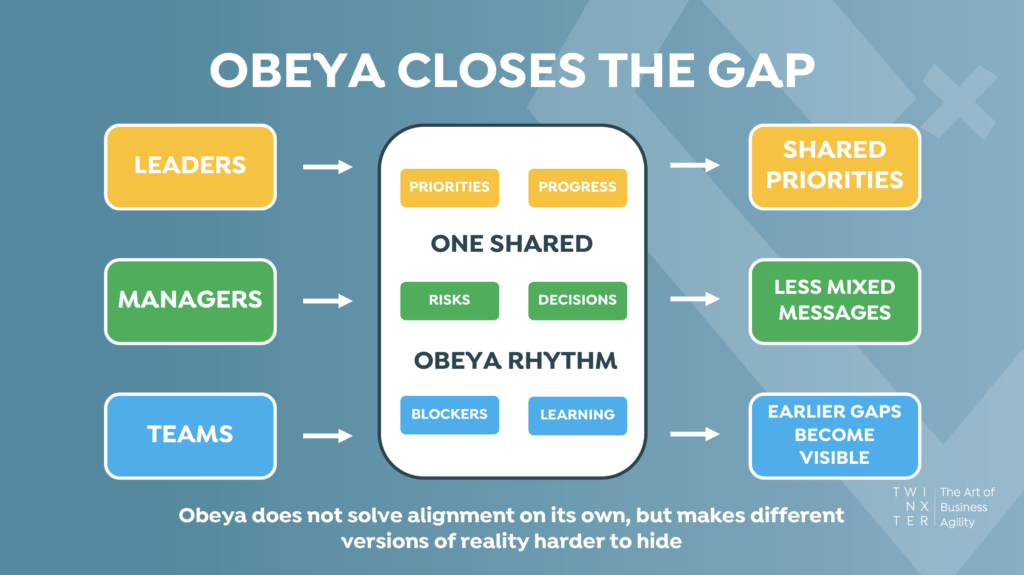
This is one reason I keep coming back to visibility and cadence. When strategy, blockers, risks, choices, and learning are clear in one shared rhythm, it’s easier to see the gap between formal direction and real life. It then becomes harder for leadership to mistake presentation for alignment. Meanwhile, managers and teams can bring up what isn’t landing clearly yet.
This is also where Obeya becomes more than a simple visual management tool. At its best, an Obeya creates one shared place. Here, leaders, managers, and teams can see the same priorities, results, blockers, and progress at the same time. This is a great way to reduce the risk of different layers of the organisation working from different versions of reality. Obeya brings strategy and execution together. It helps align direction, decisions, and lived experiences in one visible rhythm.
That is one reason I see Obeya as part of the solution here. A room doesn’t fix alignment on its own. Instead, the discipline it brings helps organisations identify gaps sooner. It encourages open discussions and makes strategy visible, so people can question and act on it together.
Real dialogue matters too. Not the type that happens after decisions are made. Instead, it’s the conversation that lets people share what they really hear. Understanding differs obviously per person. This is one of the factors that makes change harder than it looks from the outside. Shared sense-making is not a soft extra. It is a powerful way your organisation can stay connected when conditions are changing.
And leadership behaviour is of great importance, just as much as leadership messaging. If the message says focus, but behaviour rewards overload, people will believe the behaviour. If the message says ownership, but decisions keep escalating, people will trust that pattern. If the message says trust, but daily interactions feel defensive or inconsistent, then trust will not flow.
The gap closes when your people’s experiences align with what leaders say about their organisation.
The real question you have to ask
The real question is not so much about whether different layers of an organisation see different things. Of course they do. The real question is whether leaders are curious enough to see those differences as real signals and not just as background noise.
When the gap between strategy and reality grows too wide, your organisation may seem aligned on paper, but it can still start to fragment in practice. That’s when execution becomes harder. And not because your strategy was wrong, but because too few people shared the same vision.
And if that sounds familiar to you as well, then it may be worth asking a different kind of question. Not only: Is our strategy clear in the boardroom? But also, is it clear, credible, and workable in the organisation that our people experience on a daily basis?
That is where better alignment begins. If you want to explore this further, my work at Twinxter can help. It’s not just about setting direction; it’s also about ensuring that everyone in the organisation can live, see, and act on that direction.
If these insights have helped you see your organisation more clearly, and you want to explore what that could mean in practice, let’s have that conversation. Book a 30-minute call for an honest exchange about where leadership is working well, and where your design may be getting in the way.
Book your complementary call here https://www.twinxter.com/contact/

