
Don’t you also think that there is something reassuring about optimisation? Many organisations I know believe they know how to do it. In all honesty, this is true. To some extent at least. What often happens is that they improve a process, take costs out here and there, or speed up a delivery process. It can also be that it involves implementing a new digital tool, adjusting one of their customer journeys, or simply asking teams to become a little more productive. I guess you know about these things. And not to forget: there is usually some kind of business case. One that explains what is being changed, and what or how progress can be measured against something that already exists. And quite often, that is exactly what is needed.
The interesting question starts somewhere else. What happens when the thing you are improving is based on assumptions that are beginning to lose their relevance? What if customer behaviour is changing in unexpected ways? What if technology is shifting how value is created? What if new competitors are coming from outside your usual market? Or what if AI allows for entirely new ways to organise work? Interesting, right?
At this point, continuing to optimise further can feel like a sensible solution. I would like to put forward that it can actually become the more dangerous one.
A recent PwC study on business-model reinvention made me think about this again. In this study, PwC looked at over 1,800 large organisations. What they found was that companies which fundamentally reinvented how they created value achieved much stronger revenue performance. This was compared to similar companies that did not make such changes. Mind you: the benefits were not immediate. At first, there was a transition period in which organisations had to adapt the way they worked and build new capabilities. So far, so good. But once that period had passed, the difference became significant.
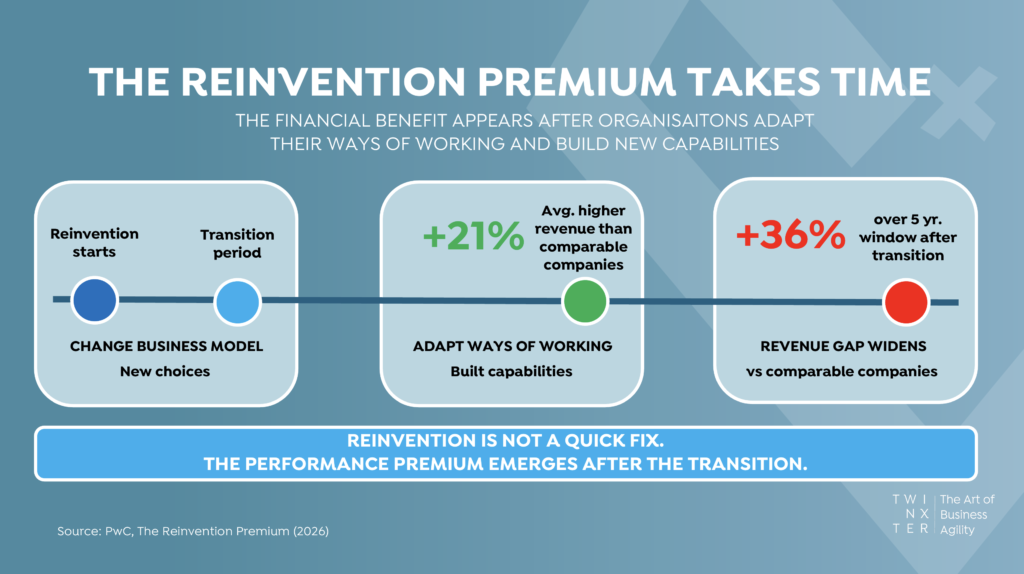
It is that combination that interests me far more than the headline percentage alone.
Because it raises two very different but important questions. The first is When does improving the organisation you already have stop making sense? The second is What happens once you actually decide that something more fundamental needs to change?
These questions were coming back to me during my holiday, so I have decided to explore both. As answering them takes quite a bit of brainpower, I want to answer them in a short three-part series on organisational reinvention.
In this first edition, I will look at the difference between optimisation and true reinvention. I’ll also go into why improving your current model can sometimes mask the need for a change. In part two, I will discuss what I call the uncomfortable middle of reinvention. This is the time when the current business must keep performing while we build a different future. In part three, we’ll explore the organisational impact of this. A truly new business model is hard to manage with an operating model built for the past.
So let us start with the first question. How do you know when better is not actually better any more?
The default answer
Most organisations are extremely good at looking for improvement. And to me, that is hardly surprising. Management systems are in general largely designed around it. Repetitive objectives aim to improve performance. Innovative AI tools automate work. I’m sure you all know about strategy cycles that spot growth opportunities. And about the leaders who are continuously asked how to boost productivity, efficiency, quality, or speed.
There is nothing fundamentally wrong with this. Really, there isn’t. In fact, an organisation that stops improving will probably create problems for itself rather quickly. These risks appear when optimisation becomes your answer to every kind of change.
Imagine that your customer expectations are moving at a faster pace than your service model. You can obviously improve the service model. If the economics of your market are changing, you can cut more costs. If new technology makes certain activities unnecessary, you can clearly automate them. And if your competitors become faster, you can try to further streamline your own processes.
Each of these individual interventions can make sense. But there comes a point where you have to ask whether you are solving the underlying problem or simply making the existing system work harder.
I have seen many organisations struggle with this distinction. Companies with a lot of internal movement, with transformation programmes that go everywhere, and where a great deal of investment has already been made. Yet, beneath all that activity, the fundamental logic of the business remains mostly intact.
You see the same customers being served in essentially the same way. The same decisions travel through the same thick hierarchy. The same functional impediments remain. The same value streams are organised around the same assumptions. Technology gets added, but the organisation itself barely changes. Not something to look forward to, right?
You can become considerably better at doing yesterday’s work without becoming any better prepared for tomorrow. That is the distinction I think deserves more attention.
Transformation does not mean reinvention
The word transformation has become so broad that almost any significant initiative can now carry the label. All around me, I see digital transformations, AI transformations, cultural transformations, operating-model transformations, customer transformations, workforce transformations, and increasingly, combinations of all of them. I find this all quite overwhelming.
It’s safe to say that some genuinely change your organisation. Others mainly modernise parts of it. PwC makes an important distinction here. Reinvention, in its research, does not mean launching a new product or improving a process. It means changing several fundamental elements of your business model at the same time. In other words, it’s about changing what value means, how it’s delivered, and how your organisation seizes that value. That places it a considerably different level.
One retailer introduces a better app that may transform part of its customer experience. Another retailer is shifting from mainly selling products to creating an ecosystem of services, data, partners, and recurring revenue. The latter is rethinking its entire business model.
Another example: a bank automating an approval process is improving its operations. Another bank is rethinking its advice, distribution, trust, and customer relationships. As data becomes more digital, it is asking a much deeper question.
The same applies to AI. Introducing Copilot or automating individual tasks may improve productivity at first glance. Redesigning entire workflows, changing where decisions are made, or reconsidering roles and value streams are something else.
It is becoming clear that AI makes that distinction quite visible too. The companies getting the strongest economic returns from AI are not simply adding more tools. They are much more likely to use AI to pursue growth, redesign workflows, and reinvent parts of their business model.
That does not mean AI has to sit at the centre of every reinvention. It does show us something important, though. New technology offers the best chances when organisations are ready to challenge the system around it.
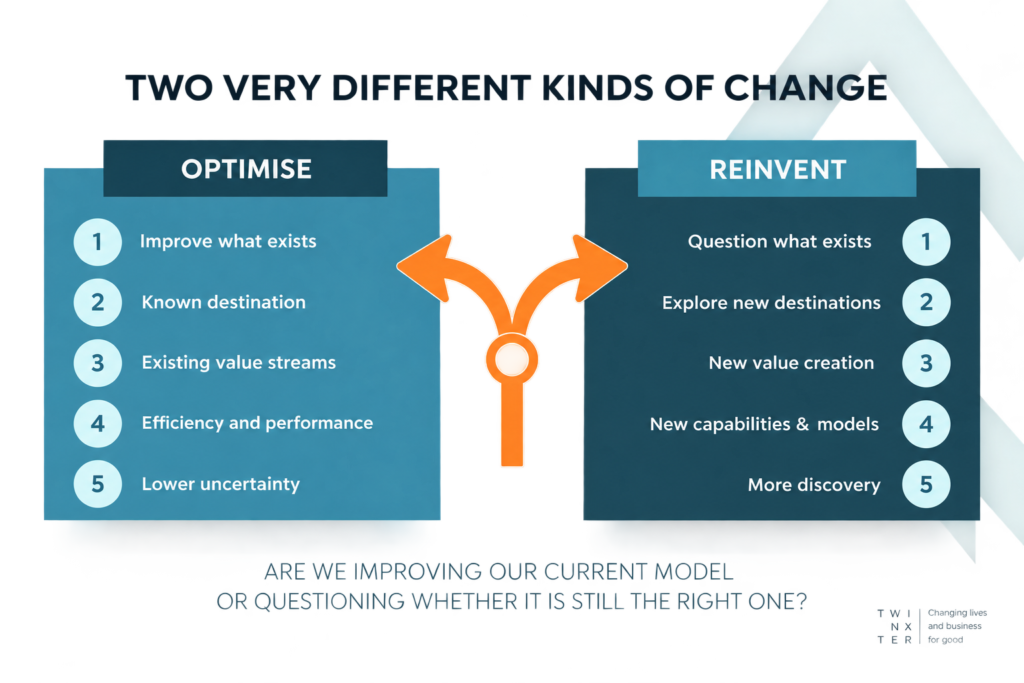
And that is exactly where optimisation and reinvention start to separate.
Successful business models
Here is the awkward part. Reinvention is probably easiest to recognise when your current model is failing. Unfortunately, that is not usually when you want to start. The real challenge is seeing the need to change while the current organisation is still doing reasonably well.
Your revenue may still be growing. Your customers may still be buying. Or your market position may still look healthy. Your organisation has even spent years learning how to operate its model efficiently. As a result, there are plenty of smart people making it better every day.
Why would you want to disrupt that? That is a perfectly reasonable question to put on the table. It also starts to explain why organisations can become trapped by their own success.
The systems around them were built to reinforce what works. Think about budgets that flow towards proven activities. Or performance metrics that reward current business KPIs. Your leaders have developed expertise within it. Existing roles and capabilities reflect it. And your governance protects it. Even the stories people tell about what makes the organisation successful are rooted in it. Amazing, isn’t it?
Over time, your model does not only become a way of creating value. It becomes part of your organisation’s identity. That makes challenging it emotionally and politically harder than a strategy presentation tends to suggest. It would be good to note that people usually are not necessarily resisting the future. They may simply have spent years being rewarded for protecting the present.
This is also why I am cautious whenever leaders conclude too quickly that their organisation needs to become “more innovative.” Innovation is really not only about generating better ideas. The harder question is whether your system gives those ideas enough space to challenge the assumptions on which today’s success is built. That’s when it becomes really interesting.
If every investment has to fit yesterday’s business case, that’s a challenge. If every experiment must meet today’s performance expectations, that’s an issue. Also, if every new model must meet current governance standards, your organisation might be pushing for change while still valuing optimisation. That is a difficult contradiction to escape.
A little confused? That’s all right. It will become clearer later on in this series.
Changing assumptions
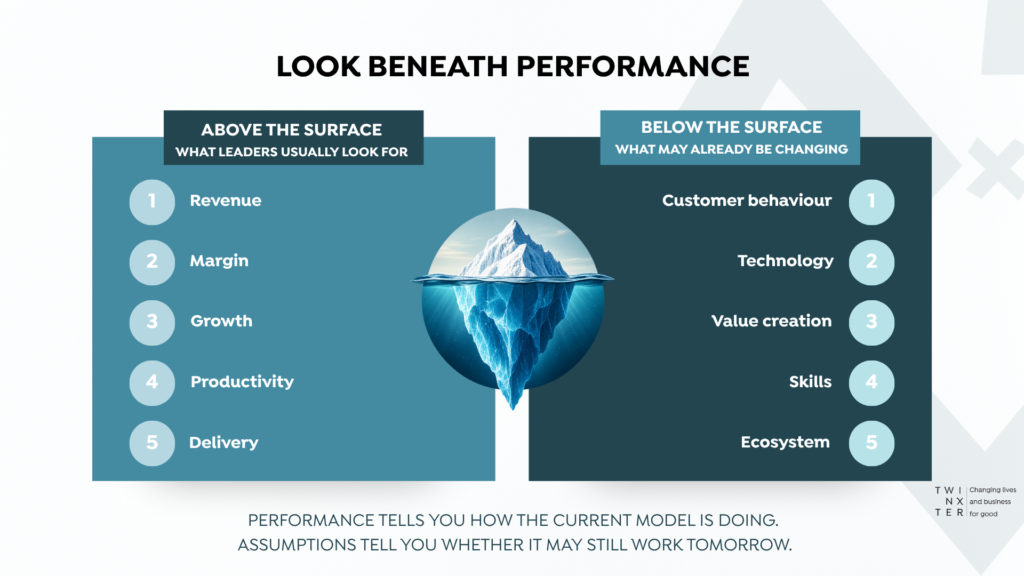
So how do you know when optimisation may no longer be enough? I would not start by looking only at performance. Performance is an indicator of something that has happened in the past. By the time your numbers make reinvention unavoidable, much of your room for manoeuvre may already have disappeared. It makes more sense to look at assumptions.
Every business model rests on them, whether they are made explicit or not. Think about customers that have certain expectations about what they value and what they’ll pay for. Or which capabilities set you apart, where expertise should be located, and how distribution functions. Additionally, think about what technology can do, what partners you need, and where your industry’s boundaries lie.
Some of those assumptions can remain valid for decades. Others can change remarkably quickly. One useful leadership conversation is therefore not simply,Are we performing?. It is better to ask Which assumptions underneath our performance are becoming less reliable?
For example, are customers starting to solve problems differently rather than simply choosing another provider? Is technology removing an advantage you previously relied on? Are new competitors making money through a model you would never have considered? Are certain skills becoming strategically more important? Are your current structures making it harder to seize opportunities that cross functional lines?
You may still decide that optimisation is the correct response. At least you’re making that choice on purpose. You’re not just assuming the current business is fine, so the model must be fine as well. That distinction becomes more important over time as the environment changes faster.
Look beneath performance
The real question
One of the reasons organisations jump too quickly into transformation activity is that changing structures and processes feels tangible. You can sense a shift when you reorganise teams, launch a new programme, introduce tech, or create new dashboards. All of those things can eventually matter. But if the business model itself is under question, I would start somewhere else. I would start with value.
Who will we create value for in the future? What problem will they actually need us to solve? What might make that problem materially different from the one we solve today? Where could completely new value emerge? And which parts of our current way of creating value are there because they remain essential, versus simply because they are familiar to us?
Those questions help you move away from How do we change our organisation?towards What organisation will our future actually require? There is also another question I would deliberately add: What do we not want to lose? I think that one is often missing from conversations about reinvention.
When organisations talk about their future, there can be a tendency to frame the present as the problem. You know, things like legacy systems, old structures or traditional ways of working. The language quickly becomes one of replacing one world with another.
But successful organisations usually have something worth protecting. It may be customer trust or relationships. Your craftsmanship or a particularly strong sense of purpose. It can also be something more like a culture of care or an ability to execute reliably. Or simply the things your people genuinely value about belonging to your organisation.
Reinvention should not mean losing those things accidentally. A meaningful North Star, therefore, needs more than an attractive description of the future. It needs to make some choices visible. What are we moving towards? What are we genuinely willing to rethink? What is negotiable and what is not? And as we build something new, what do we want to make absolutely sure comes with us?
That creates a much stronger foundation for change.
Optimising and reinventing
Optimising and reinventing may need to go hand in hand. This is where it becomes slightly more nuanced, as I do not think the answer is to stop optimising and start reinventing. Most organisations cannot simply abandon today’s business while they design tomorrow’s future.
Your company’s model still serves customers. It still generates revenue. It still employs people. In many cases, it will fund a significant part of whatever comes next. So your real leadership challenge is often learning how to do both.
You need to continue improving the engine that keeps your organisation functioning. At the same time, you have to give another part of your system permission to question whether that engine will remain sufficient over time. That requires different thinking. An optimisation initiative usually begins with a fairly clear destination. You already know what good looks like and are trying to get there more efficiently.
Reinvention takes much more discovery. You are testing your assumptions and exploring new possibilities. You are combining your skills in different ways, and you are also learning things that might change your original direction.
If you govern both in exactly the same way, the known business usually wins. This is due to clearer numbers and stronger evidence. There’s a solid customer base and familiar measures. Influential people are involved, and there’s also a more predictable return. The future starts at a disadvantage.
That is why leaders need to be deliberate about creating enough space for both horizons to exist. This isn’t about putting innovation in a bright corner and hoping for something magical. It’s about making clear strategic choices, showing investment logic, and sharing what we learn. This approach helps your organisation understand what it is trying to discover and why.
There has to be a connection between today’s performance and tomorrow’s possibilities. Otherwise, reinvention becomes either too disruptive to sustain or too peripheral to matter.
Questions on the table
If you are wondering whether your organisation is still optimising the right model, I would not immediately launch another intensive and costly transformation programme. I would first create a safe space to have a different kind of conversation about the issue at hand.
There are a few questions I find useful during such a process. There are many more, but this will help you to get started.
- What assumptions about our customers, market, or value proposition do we see as facts just because they have been true for a long time?
- Where are we improving our activities due to new technology or changes in customer behaviour?
- Which part of our success could turn into a weakness if our ecosystem changed a lot?
- Are our transformation investments changing the way we create value? Or are they just helping us do our current work faster and cheaper?
- What skills could be vital for our future but are still minor in our organisation now?
Please note that you don’t have to have dramatic answers to all of them.
But the quality of the conversation you have around these questions does matter. If these questions are hard to talk about because they keep going back to today’s targets, structures, and obstacles, that’s useful information too. You may have found one of the reasons reinvention is difficult before it has even started.
Standing still successfully
What I find most interesting about this whole topic is that it’s not simply saying that reinventing your business model eventually leads to more revenue. It is the delay of it.
Organisations typically move through a transition period before enhancing their performance. They have to adapt their ways of working and build new capabilities before the financial benefit becomes visible. A difficult conversation that I keep having with the CFOs of those companies as they tend to focus more on quick and obvious ROI. And that is obviously not without reason, but it does not entail the full body of it. It also tells us something important about the leadership of your company. If you wait until your future model can prove itself using the same certainty as the existing one, you may wait too long and become obsolete.
Reinvention asks leaders to make choices while maintaining both realities. The existing business is tangible, measurable, and usually more predictable. The emerging one contains more questions than answers. That is uncomfortable. But the alternative is not necessarily safer either.
Your organisation can still hit targets and improve processes. It can even become more efficient, while the assumptions behind its success weaken over time. Once everyone sees that reinvention is needed, competitors might have already figured out what you’re just starting to learn. Not a place where you want to be.
So perhaps the question is not whether optimisation is good or bad. That is too simple. The more useful question is whether you are optimising something that still deserves to be optimised. And if the answer becomes less certain, that is probably the moment to start looking beyond improvement. Because deciding to reinvent is only the beginning.
And if you recognise this in your own organisation as well, I would be happy to have that conversation with you. Sometimes the most useful starting point is simply to step away from your current transformation agenda for a moment and ask whether you are still improving the right model in the first place.
In the next edition of this three-part series, I want to go into what happens after that decision has been made. The benefits of such a reinvention take time to emerge, and that waiting period deserves much more attention than it usually gets.
Your old organisation still has customers to serve and targets to meet. At the same time, new capabilities have to be built and old assumptions questioned. Current roles and ways of working begin to shift, and people have to make sense of a future that is not yet fully visible.
I call that the uncomfortable middle of reinvention.
And I suspect that what happens there has at least as much influence on the outcome as the original strategy does.
If some of these questions are starting to surface in your organisation, I’m always interested in comparing notes. Sometimes an outside perspective is useful in distinguishing between what still deserves to be optimised and what may need to be questioned more fundamentally. Feel free to reach out.
If these insights have helped you see your organisation more clearly, and you want to explore what that could mean in practice, let’s have that conversation. Book a 30-minute call for an honest exchange about where leadership is working well, and where your design may be getting in the way.
Book your complementary call here https://www.twinxter.com/contact/

