
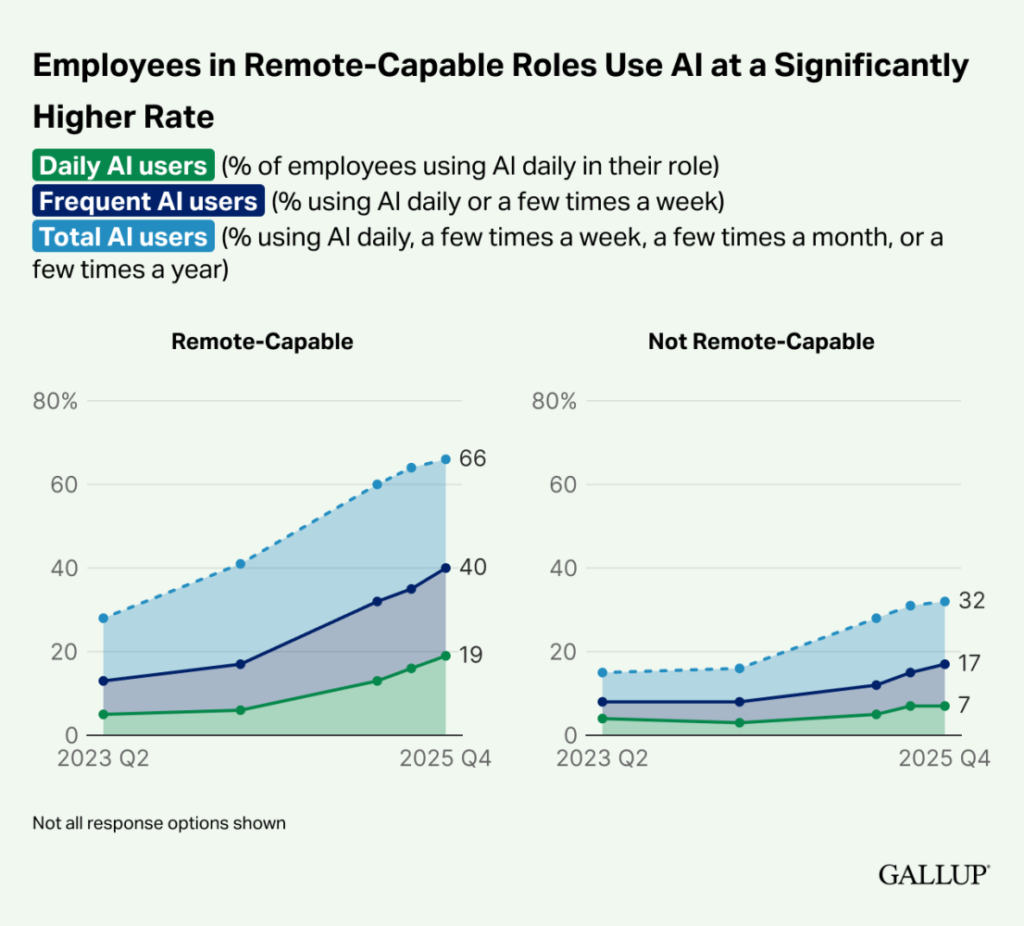
I think we can all agree that AI is making our work faster. At least in general, I would argue. As many workers already use it, that part is no longer theoretical. Gallup (Frequent use of AI in the workplace, 2026) found that, by 2025, 66% of employees in remote-capable roles were using AI at work. And that includes40% who used it frequently and 19% who used it daily. An even more recent update by Gallup (Rising AI adoption spurs workforce changes, 2026) shows that AI use is further increasing among employed U.S. adults. Now, 50% say they use AI in their jobs at least a few times a year.
So yes, the acceleration is real. Things like making drafts are faster. Creating a summary comes quicker. I’ve seen research starting earlier as a result of using AI. Also, ideas tend to multiply sooner. And let’s not forget, people can produce more in less time. That is visible in the daily work of most already. And yet, many organisations do not feel lighter.
That is my starting point for this newsletter. Because when people say AI is speeding things up, I think the more useful question is not whether the tools are faster. Because we all know they are. The real question is why so much work still feels slow, takes forever, or is harder to move than it should.
The answer, in my view, is that AI is indeed accelerating output. However, the main value in organisations was never just in these tasks. That value sits in other things. Things like unclear priorities, overloaded managers, decision-making that climbs too high, and endless updates that create movement on paper but not in practice. In work that becomes faster to produce, but not easier to align, absorb, or act on.
That is where this article begins. I don’t want to treat AI as a miracle nor as a threat. Let me start with an open question: if AI is speeding up work, what is still slowing us down?
AI is making tasks faster, but not necessarily work cleaner
Faster task execution is not the same as cleaner organisational movement. For me, this is one of the most important distinctions to make.
Recent HBR research (AI doesn’t reduce work, 2026) shows that AI often did not reduce work in the way people expected. Instead, it increased pace, widened their scope, and also pushed work further into breaks and evenings. The argument that they put forward is that AI does not necessarily reduce work, it can actually intensify it.
That insight is an important one. It explains why organisations can feel more productive and more pressured at the same time. AI helps people move faster through job tasks, but it doesn’t automatically decrease the work coming into your system. In some cases, it simply raises the rate at which output arrives. More drafts. More options. More recommendations. More material to review. Etc., etc. More things that now need a decision, alignment, and response.
I also read some work from McKinsey on agents, robots, and people (Skill partnerships in the age of AI, 2025) that points in a similar direction. It says work is now a partnership between people, agents, and robots. Writing this down makes me realise how far we have already come with regard to the use of AI in our work. The main challenge isn’t just automation, but how work and skills are changing with that partnership. In other words, AI does not simply remove work. It changes our work in terms of shape, its pace, and what humans still need to hold.
That is where I think many organisations are slightly fooling themselves. They see faster tasks and therefore assume the whole system has become faster. But a faster input does not guarantee a smoother flow.
The actual pain is usually found elsewhere
In my own work, I rarely see progress lose momentum because people cannot produce enough. Much more often, it stops because an organisation cannot absorb all that is being produced well enough.
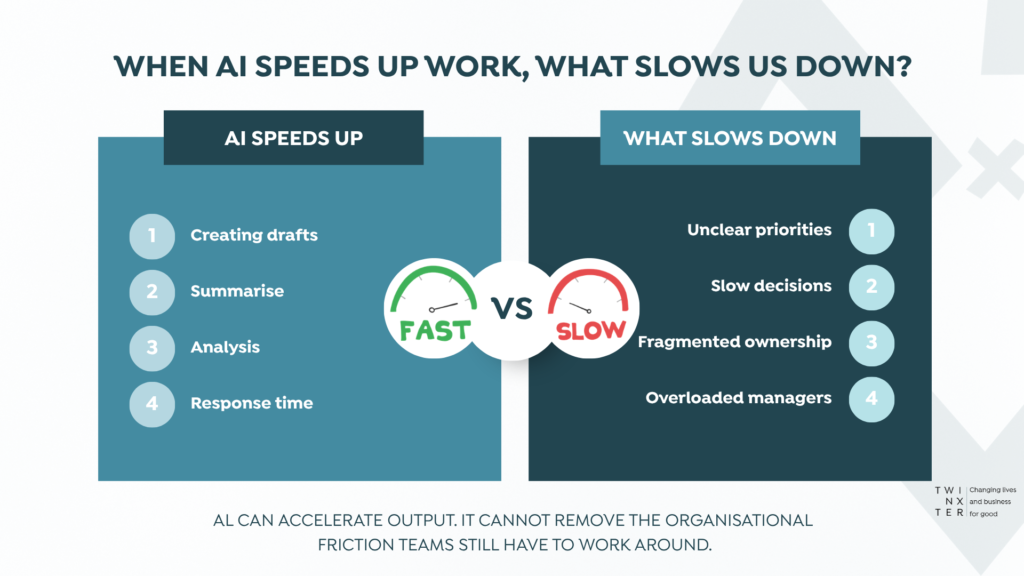
That is a friction that I see quite a bit. Consider the priorities that clash or the strategies that shift tone as they move through different levels of the organisation. Managers then spend too much time translating what should already be clear. Teams generate more output than the decision-making rhythm can handle. Work becomes visible too late. Ownership remains fragmented. Good people are moving, but not always in the same direction.
This is where AI becomes more revealing. It speeds up the layer of work that was already easiest to accelerate, the drafting, the searching, the summarising, or the generating. If the organisation isn’t clear about what matters most (i.e. decisions, ownership, visible progress), then AI might boost individual effort, but the overall system could still be stuck.
That is why this topic is so important. AI is not only making work faster. It is also bringing old issues to light faster.
More output does not solve unclear priorities
If it’s true that AI helps teams do more in less time, but organisations can’t prioritise what matters, then the output just piles up faster and faster. The speed is real, but the movement is not. This is one of the first places where you will notice friction becoming obvious.
I see this often when leaders say they want more productivity, but keep the organisation’s portfolio too full. The team has better tools and can work faster in some areas. However, the pressure continues because too many priorities compete for attention.
That is why I would be careful with the language of efficiency on its own. Efficiency is clearly not useless. At the same time, it can become misleading when it hides the fact that your organisation is still asking people to move in too many directions at once. In such scenarios, AI can turbocharge your productivity, but it’s not a magic wand. While it speeds up production, it can’t spare you from the price of poor choices. The cost of missteps still lingers, reminding us that speed alone won’t guarantee success.
Faster work can still lead to slower decisions
There is another layer to this. AI can accelerate individual output, but it does not automatically accelerate collective decision-making. And this is where many teams start to feel the mismatch. They produce faster, but then they wait. They wait for decisions. They wait for alignment. They wait for approval. They wait for someone to make sense of conflicting inputs. They wait for clarity on what should move and what should stop. That is a lot of waiting that can be avoided.
If AI helps teams produce more quickly, but your organisation can’t decide what matters, the output just stacks up faster. The speed is real, but the movement is not. This is one of the first spots where friction shows up. Faster production doesn’t help much if the work goes into a system that can’t prioritise clearly.
That connects quite well to what people experience with AI. They have become quicker at generating options, but not necessarily better at deciding among them. In fact, faster generation can sometimes make the decision layer more cumbersome. There is more to review, more to compare, more to challenge, more to align, and so on.
So at this moment, AI is not only helping work move faster. It is also putting more pressure on parts of your organisation that were already too slow.
Managerial layer to feel this first
AI often starts with individual users, but its impact quickly reaches mid-level. Managers help teams understand new expectations. They manage the increase in output, keep focus, translate priorities, and decide what to do next. That is one of the reasons why the managerial layer matters so much in this conversation.
The problem is that the middle layer was already under strain. In recent newsletters, I already referred to Gallup’s research on the Global Workplace. This 2026 report reveals that employee engagement fell 1% point to 20% in 2025. But managerial engagement dropped from 27% to 22%. Most of this decline was due to work pressure. And that is important in our context because it means we are not using AI in a calm, spacious system. It is being used in organisations where the managerial level is already carrying too much of the load.
So when people ask why work still feels pressured despite better tools, this is part of the answer. The tools may be faster, but the layer that has to absorb, progress, and turn that speed into usable movement is already overloaded.
AI is often speeding up the wrong thing
The phrase AI is often speeding up the wrong thing may sound a bit unfair, but I think it captures something real. Many organisations are using AI to speed up things that were never their biggest constraint in the first place. Things are being produced faster, while decision rights are unclear and priorities change. Doing research might become easier, but ownership stays fragmented. Individual output improves, while collective rhythm remains weak.
A last piece of research I want to mention is from BCG (AI will reshape more jobs than it replaces, 2026). This adds some useful context here. It mentions 50% to 55% of jobs in the U.S. will be reshaped by AI in the next two to three years. Many people will keep similar roles, but how they work will change a lot. So, the challenge here is not only about adoption. It is also about the redesign of your organisation.
And this is where I think the real opportunity sits for many. AI should not only help people move faster inside the same old friction. It should provoke a more honest conversation about the friction itself.
What is actually slowing us down
If I break it down, I think the things still slowing many organisations down are surprisingly familiar:
- too many active priorities at once
- decision-making sits too high or too vaguely in the system
- managers acting as human routers for unclear direction
- endless coordination replacing visible shared progress
- work that is becoming faster to produce but not easier to absorb
- more speed without enough rhythm
And believe me, none of those are solved by a better prompt. They can be resolved by making better choices, improving decision-making, and setting clear priorities, such as using Obeya. And not to forget, by a more honest view of what workload teams can actually carry.
That is also why I would resist turning this into a purely technology conversation. Sure, AI matters, but the more useful conversation is about what AI is exposing in your organisation. This deals with where your organisation still confuses speed with progress. It also reveals where faster work keeps colliding with slower clarity. In other words, it is showing you where output is accelerating faster than your shared and collective understanding.
What helps now
If AI is accelerating your output while the underlying obstacle stays untouched, then the answer is not simply to use more AI. The more useful question is what needs to change in the way you operate. The way work is prioritised, decided, and executed so speed can actually turn into progress. In my view, this is where many organisations still have the biggest opportunity. Not in producing more, but in reducing the friction that keeps good work from moving through your system.
A few shifts that are important to consider here.
- Reduce the number of competing priorities. If AI helps your teams work faster, then it becomes even more crucial to focus on what truly matters. More output without sharper choices only creates a faster mess.
- Make decisions cleaner and more visible. If your system depends on constant escalation, unclear ownership, or slow decisions, things will get worse. Fast work upstream just leads to more waiting downstream.
- Create one shared rhythm of delivery. Work moves better when people can see what matters now, what is moving, what is blocked, and where attention belongs. Without that, AI might increase the suggestion of motion without creating the required coherence.
- Make invisible work visible. This is where Obeya becomes practical rather than theoretical. If your system can’t see where friction occurs, people end up making workarounds themselves.
None of these shifts are very glamorous, and that is precisely why they are important. The real slowdown in organisations is rarely caused by one dramatic failure. It often sits in the day-to-day friction that keeps speed from becoming clear and output from becoming movement. If AI is exposing that friction more clearly in your organisation, then that is not only a problem. It is also an invitation to finally deal with what was already slowing work down in your organisation, long before AI even arrived.
The question underneath it all
The question, then, is not whether AI is speeding up work. It is. We can put that to rest. The better question is whether your organisation is taking serious steps to eliminate the friction that this speed is creating. If it isn’t, AI risks becoming just another layer of acceleration in a system that is still being slowed down by old habits. This creates more output, more intensity, more expectation, but not necessarily more clarity, alignment, or meaningful movement. So, that is something to think about.
If this sounds familiar, that may be useful in itself. It may mean that the real opportunity might not just be to adopt AI faster. It could also be to carefully examine what still slows down work in your organisation after the tools have done their part.
And if you want to explore that more deliberately, this is also where my work at Twinxter can help. This is especially true when the challenge isn’t the technology. It’s about having clarity, rhythm, and a shared focus to turn speed into progress. Happy to connect.
If these insights have helped you see your organisation more clearly, and you want to explore what that could mean in practice, let’s have that conversation. Book a 30-minute call for an honest exchange about where leadership is working well, and where your design may be getting in the way.
Book your complementary call here https://www.twinxter.com/contact/

