
Over the years, I have seen the same patterns return in very different organisations. Leadership suddenly becomes a topic of some concern. The usual response is then to zoom in on the individual. Leaders are asked to communicate better, decide faster, create more ownership, build trust, and guide teams through increasing complexity. Often, a training or coaching of some sort is added, or competency frameworks to support that. I think you know all about that. None of this is wrong in itself, but I kept noticing that these kinds of efforts mostly improve things only at surface level. As a result, the underlying issue remains.
And that is what I keep noticing. Many organisations ask for a certain set of leadership behaviours without paying enough attention to the surrounding conditions. They want clarity while priorities keep shifting. They want ownership while decision-making is still escalated. They want adaptability while teams are already overloaded. They want trust while control remains deeply embedded in their system. In other words, they see leadership mainly as an individual skill. However, many factors that boost or hinder that leadership lie in the design of their own organisation.
That is the reason I thought of a way to make this visible. A way to see what I keep experiencing. And that is that leadership doesn’t become sustainable just because a few people start trying harder. When it does become stronger, it is when an organisation creates the right conditions for it to take root and stay visible in daily work.
So, I needed a model to connect three key areas: the leadership focus, what happens in the organisation when leadership is effective, and the system conditions that help or hinder those results. That is what I want to share with you in this newsletter.
This piece is not an argument against leadership development. Not in the least. It is an argument for widening the scope. Leadership matters enormously, but it does not live in a vacuum. It is shaped by purpose, trust, and rhythm. It depends on how decisions flow, what space people have to learn, and whether their organisation supports the behaviours it claims to want. That is why I have started thinking about leadership less as a heroic characteristic. Instead, I view it as something we can hold, strengthen, or weaken by design. Let’s dive into it further together.
Why leadership so often feels harder than it should
One of the most common trends I notice is that organisations seek stronger leadership. They often jump straight into asking about individual development. They want more alignment, better or quicker decisions, more ownership, higher adaptability, and a healthier culture. As mentioned before, on many occasions the answer then becomes some form of leadership development, coaching, workshops, competency models, feedback rounds, or a new set of expectations. Again, none of that is wrong. The problem begins when leaders think leadership is just about them. Meanwhile, their organisation often undermines this very effort.
You can ask a leader to create clarity, but if priorities keep shifting every week, clarity will always remain somewhat fragile. You can ask for ownership, but if every meaningful decision still needs escalation, real ownership remains a farce. You can ask teams to be adaptable, but overloading them or failing to connect them properly can lead to resistance. If they have no space to learn, adaptability will be gone with the wind. You can ask for trust, but if the real system still rewards control, trust will never become more than a slogan on your wall.
That is why leadership often feels much harder than it should. The behaviours sound right, the intention is usually there, and even the language can be familiar. Yet your organisation keeps producing the opposite of what it says it wants. This is precisely why I felt we needed a better approach. Something that not just lists desirable leadership qualities but also shows the organisational conditions that make those qualities possible.
A different way to understand leadership
This is the thinking behind what I have come to call the Adaptive Leadership System. The foundation of this system is based on a simple idea: leadership does not struggle only because people lack qualities. Leadership struggles when organisations expect the right behaviours without creating the conditions to support these behaviours.
The Adaptive Leadership System has three layers, and the order matters because it changes the whole conversation. At its core sits what leadershipfocus should continuously uphold: Purpose, People, Decisions, and Value. The second layer represents the organisational capabilities that become visible when leadership is working well: Alignment, Clarity, Adaptability, Ownership, Energy, Development, and Connection. The third layer describes the enabling conditions: Shared Purpose, Governance of Trust, Rhythm of Delivery, and Learning Environment.
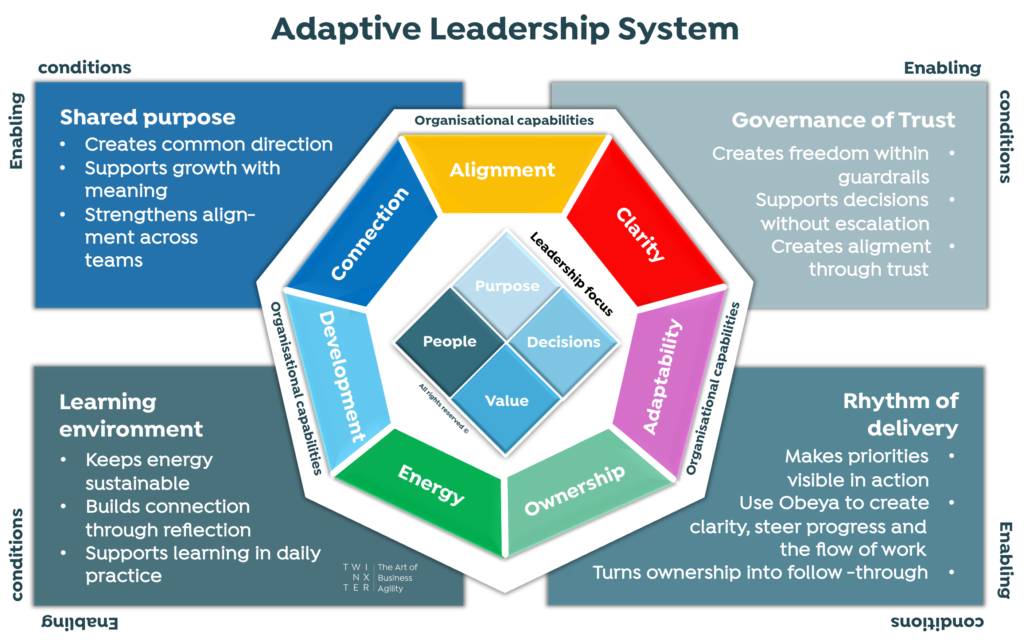
What I find useful about this structure is that it stops leadership from being reduced to a competency list. The middle ring is, for example, not a set of personal qualities. It shows you what becomes visible in an organisation when leadership is properly supported. That distinction matters because it shifts the question from What should leaders do better? to What is helping these qualities emerge, and what is blocking them?
Once you start looking at leadership that way, the conversation becomes much more open and authentic. You stop assuming that weak ownership automatically means weak leaders. Or that low adaptability automatically means that teams are resisting. Instead, you begin to ask whether your organisation has actually created the right conditions for ownership, adaptability, clarity, and connection to take root in the first place.
What leadership has to hold at the centre
At the centre of this system sit four elements that leadership needs to keep in view at the same time. In practice, I see a lot of organisations where purpose is turned into a business KPI. People get overshadowed by targets, decisions get delayed in confusion, or value gets mixed up with activity.
These four are here to remind us that leadership becomes stronger when these four stay connected and are held in balance.
- Purpose helps leaders stay linked to direction and meaning. This way, people see the bigger movement to which they belong. When you note that purpose is not grounded enough, leadership tends to appear engaged but hollow at the same time.
- People keep leadership human, grounded, and connected to how work is actually being experienced. When people are not engaged, leadership becomes more transactional.
- Decisions keep leadership from becoming vague. Progress relies on making choices and following through. When decisions lose connection, trust, and human grounding, then leadership becomes vague. Good intentions remain, but uncertainty slows movement down.
- Value keeps leadership focused on meaningful contribution, rather than on activity for its own sake. When value starts to fade, activity grows, but meaningful progress does not.
Strong leadership keeps all four in play at the same time. It keeps asking why we are doing this, how people are experiencing it, what decisions need to move, and what value is actually being created. That sounds simple when written down, yet in real organisational life it is quite demanding.
It is also one of the key reasons why leadership needs more support from the organisational system than most realise. If distractions keep pulling focus from these four areas, even strong leaders can lose clarity.
What starts to show up when leadership works well
The middle ring of the model is where things become even more tangible. When leadership is supported well, certain organisational capabilities begin to show up more clearly. Some qualities stand out in how people collaborate, how decisions are made, and how the organisation reacts under pressure. That is why I describe these not as personal competencies, but as organisational capabilities. Not as claims on a poster (nice but not successful by themselves), but as lived qualities in the way people work together.
- Alignment, because people understand the direction and can connect their work to it.
- Clarity, because priorities, expectations, and choices are easier to understand.
- Adaptability, because teams are able to respond without losing themselves every time reality changes.
- Ownership, because people can act without constantly waiting for permission.
- Energy, because the work is demanding but not endlessly draining.
- Development, because growth is built into the work rather than left outside it.
- Connection, because people are not operating as isolated parts of a machine but as contributors within a shared movement.
What matters here is that these are not simply the characteristics of someone’s personality. They are signs of how your organisation is functioning. That is why I describe them as organisational capabilities. They tell you something about the quality of the environment, not only about the behaviour of one individual leader. Once you read them like that, the next question is clear and helpful: what conditions make these capabilities possible? And where are they getting blocked?
The conditions underneath the behaviour
This is the part I find most important, because it explains why leadership so often gets discussed at the wrong level. The outer layer of the system is made up of four enabling conditions that support the visible behaviour in the organisation.
They are not extra features surrounding the system. They are the underlying conditions that either support the organisational capabilities in the middle ring, or weaken them before they have a chance to take root.
- Shared Purpose,
- Governance of Trust
- Rhythm of Delivery
- Learning Environment
These are not nice extras surrounding the model. They form the foundation at the base of it. So let’s address them together one by one.
- Shared Purpose. When purpose is genuinely shared, it creates common direction, helps people make sense of change, and strengthens alignment across teams. Because the work is connected to something that matters, it stops being a list of activities. In this sense, purpose is not a slogan nor a direction. It is your anchor that helps people decide, prioritise, and stay connected when complexity rises.
- Governance of Trust. Many organisations say they want ownership, but keep governance set up in a way that trains people not to own anything. Decisions are escalated, which becomes normal, while control stays concentrated. Then you have leaders who wonder why taking initiative is a weak point in their teams. A Governance of Trust creates freedom within guardrails. It supports decisions without constant escalation and makes trust visible in the way work is actually organised. Trust is not something that is built only through good intentions. It is built through the daily experience of whether people are genuinely allowed to act. For me, this is one of the strongest differentiators in this system.
- Rhythm of Delivery. Another condition that is often underestimated. It is the place where priorities stop living only in endless slide decks and start becoming visible in action. Rhythm helps people see what matters now, what is moving, what is blocked, and what needs attention. It creates a cadence that turns ownership into follow-through. Visual management is one of the clearest ways to make priorities, progress, and constraints visible in the flow of work. Creating a digital or physical Obeya room fits therefore naturally into this system. So, without rhythm, even strong leadership becomes difficult. Everything starts to compete for attention.
- Learning Environment. A lot of organisations say they value learning, though keep designing work in a way that leaves no room for it. Daily work piles up and becomes reactive, so reflection, growth, and improvement keep getting delayed. A true learning environment is much more sustainable. It connects through reflection and makes learning a daily habit. It’s not just for quiet moments that never come anyway.
Once you look at leadership through these enabling conditions, you will note that the conversation changes. You stop asking only what leaders should do better. Instead, you start asking what in your system helps leadership shine and what makes it tougher than it needs to be. That is a much more productive and helpful question.
Why organisations keep misreading the problem
I see many leadership conversations still going wrong. Your organisation sees a lack of ownership and assumes people need to step up. It sees weak alignment and assumes leaders need to communicate more. It sees low adaptability and assumes teams need to become more agile and resilient. It sees that decision delays occur and assumes that managers need to be bolder.
Sometimes that is partly true. But most of the time, the behaviour that people desire is undermined by their organisational design. It’s like this: ownership remains weak when decision rights are unclear. Clarity remains fragile when direction is not truly shared. Adaptability becomes superficial when teams are overloaded. Connection is absent when learning and reflection never get protected. And energy keeps dropping when rhythm is missing and urgency becomes permanent.
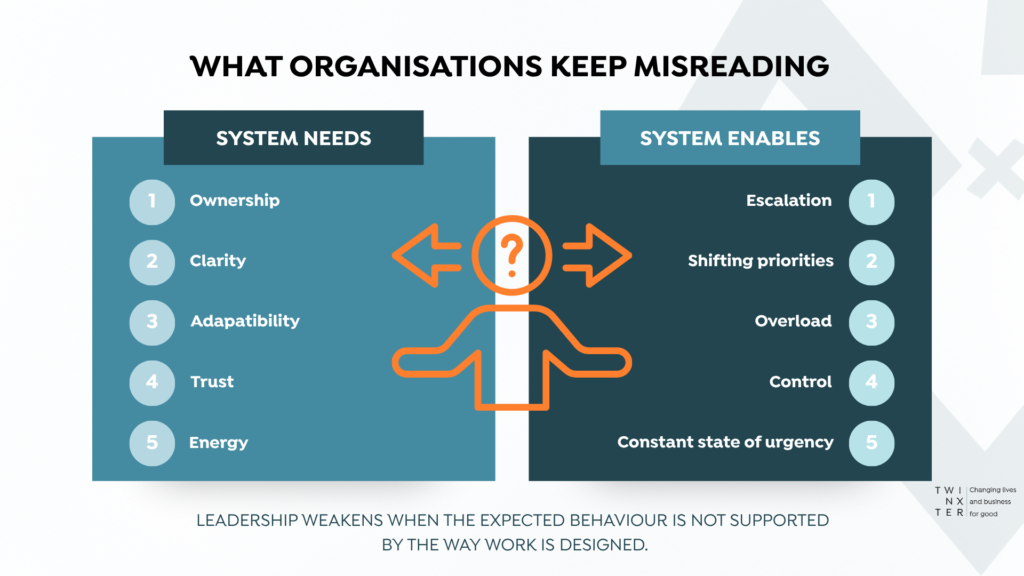
This is why I do not find competency-only models strong enough on their own. They can describe the qualities we want, but they often do not explain why those qualities fail to become sustainable in the real world. It is my conviction that the Adaptive Leadership System closes that gap. It reminds us that leadership is not just something people bring. It is also something your organisation either enables or prevents.
What this changes in practice
Once you start looking at leadership this way, several practical shifts follow. Leadership development becomes less isolated and is now connected. This is because it is no longer only about teaching leaders new skills. It also becomes about asking whether the surrounding design helps those skills thrive in reality.
Culture becomes more concrete as well. Instead of talking about culture as values on a piece of paper, you begin to see it as the result of how purpose, trust, rhythm, and learning are built into daily work. Governance stops being a bureaucratic topic and becomes a leadership one. This change happens due to how decisions are made, how escalation occurs, and how autonomy is limited. All these factors influence whether leadership can be shared or if it returns to heroics.
From this perspective, visual management and Obeya also become more relevant. If clarity, rhythm, ownership, and follow-through matter to your organisation, then the way priorities and progress are made visible should matter too. That is one reason Obeya fits so naturally inside the system. To me, this is certainly not an add-on. It is a powerful way to keep leadership and governance in check, and not left open to interpretation.
Perhaps the most important practical shift is that the starting point of the conversation changes significantly. Ask not why leaders lack the right behaviours. Instead, ask what conditions encourage those behaviours and what conditions obstruct them. This makes the conversation less about judgement and more about diagnosis. That’s often where good design work starts.
Why this model feels useful now
What I like about the Adaptive Leadership System is that it brings several of my past ideas, models, and learnings together without losing simplicity. I hope you do too. Purpose remains real, not decorative. Trust becomes operational, not sentimental. Rhythm becomes part of delivery, not a side topic. Learning becomes part of the work, not an afterthought. And leadership becomes a systemic issue, not a hero story.
This is particularly important now. Organisations deal with more change, complexity, interdependence, and uncertainty than ever before. In such an environment, asking individuals to simply be better leaders is not enough. The surrounding design matters too much.
If leadership feels more fragile than it should in your organisation, the solution might not just lie with the leader. It might sit in the gap between what your organisation expects and what it actually enables. That is the question underneath this whole model. It is not only about what leadership we want, but also about what we are doing, structurally and culturally, to make that leadership possible.
Where this conversation becomes useful
Obviously, I hope, and kind of assume it does, this hits home as you would not have made it this far. It may be because you are already seeing some of these challenges in your own environment as well. Perhaps your organisation may want more ownership, but escalation is still the go-to option for many. Perhaps it wants more clarity, but priorities are still too fluid. Perhaps it wants more adaptability, but teams are already overloaded to onboard it. Or perhaps it wants a stronger connection, but your system leaves no room for reflection or learning.
Those are not small issues. They describe exactly where leadership begins to feel either limited or empty. That is why I believe this is an important conversation to have. Leadership is too important to reduce to a list of competencies, and too systemic to leave only to individual effort.
For those who want to explore this more deeply, this is where my work at Twinxter can help. Whether it is through defining your connected purpose, building a governance of trust through Obeya, or leadership development. I’m happy to ignite that conversation with you and explore how your organisation can become high-performing as well. Let’s connect.
And if this Adaptive Leadership System speaks to you in particular, it may help you see leadership differently. Instead of seeing it as a must-have, consider it something your organisation can create more intentionally.
If this model resonates and you want to explore what it could mean for your organisation? Let’s have that conversation. Book a 30-minute call for an honest conversation about where leadership is working and where your design might be getting in the way.
Book your call here ▶ https://www.twinxter.com/contact/

