
Most teams do not hesitate because they suddenly forget how to do their jobs. They hesitate because the system around them keeps asking for more than they can handle. That is a different problem, and this matters because it leads to a very different response.
When leaders assume the issue is capability, they generally reach for the usual fixes. More training. More tools. More support materials. More expectations. And so on. Sometimes all of that is useful. It really is. But when the real constraint is capacity, those fixes can become part of the overload instead of the answer.
That is a pattern I consider worth taking a closer look at. You see, a team can be smart, committed, and genuinely capable while struggling to move forward at the same time. The people know the work. The intent is there. And the experience is there. Yet, progress slows down, decisions take longer, energy feels uneven, and change feels more difficult than it did a few months ago. At that point, the question is no longer whether your team can do the work. The real question is whether the work they are asked to do lets them move forward.
That is what this newsletter is really about. It is not a case for lowering ambition. It’s time to honestly assess what teams are expected to handle. Often, good people seem to stall because their surroundings have become too overwhelming.
Capability and capacity are not the same things
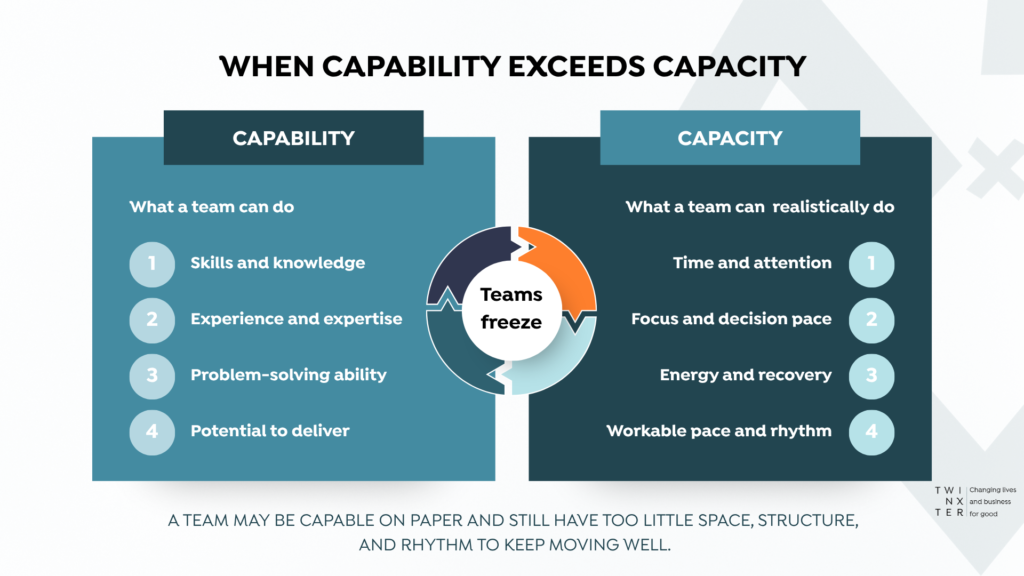
This is where many organisations blur two things that should be kept apart.Capability is about what a team knows, what skills it has built, and what it should, in principle, be able to do. Capacity is about something much more practical. It is about how much your team can realistically do, take on, hold, prioritise, and sustain without losing focus, quality, or trust in the process.
A team may have the capability to deliver several major priorities. This, however, doesn’t mean it can do everything at once. It still has to manage daily tasks. And of course, there are frequent interruptions, changing expectations, and limited time to recover. That gap is where the hold-up begins.
It also explains why many teams look to underperform when they are actually overloaded. From a distance, your team may appear to have everything it needs. In reality, attention is fragmented, decisions are stacking up, and the emotional energy to keep going is too stretched.
Why good teams often hide the problem for too long
This is one reason the issue can actually stay invisible for quite a while. Good teams compensate. They stretch. They work around broken sequencing. They absorb extra asks. They keep delivering longer than is healthy, which can make leaders think the system is still functioning well.
For a period of time, that can even look like resilience. The team still shows up. Projects still move. Deadlines are still being met, at least on the surface. But underneath, something starts to change. People stop thinking ahead because they are busy clearing the next obstacle. Work gets started more easily than it gets finished. Priorities collide. Recovery is out the door. The team is becoming more and more reactive. This isn’t due to the people’s skills; instead, the internal system limits their ability to perform well.
That is often the real beginning of a standstill. Not always a dramatic breakdown, but more a gradual loss of flow.
The manager layer is under pressure
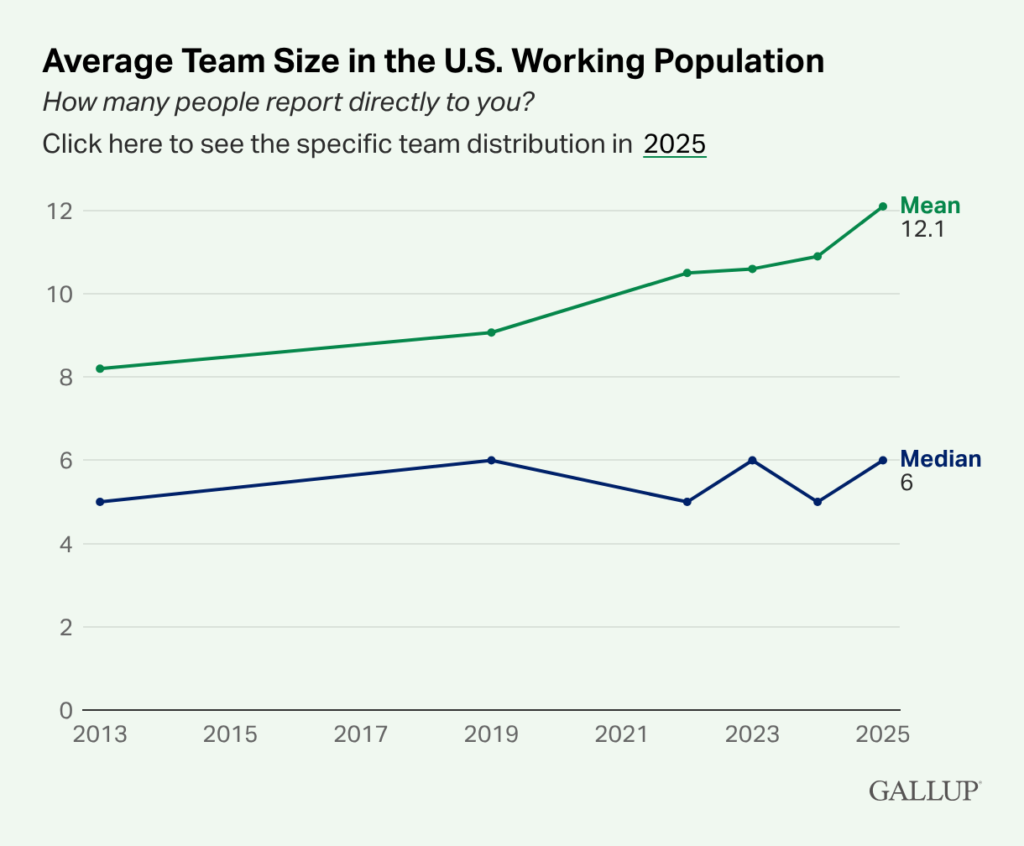
One of the clearest signals for such a disruption sits with managers. Recent research by Gallup shows that the average number of direct reports per manager increased from 10.9 in 2024 to 12.1 in 2025. This marks nearly a 50% rise in team size since Gallup started tracking it in 2013. And I assure you that this matters. As the span of control increases, it becomes harder to keep coaching quality high. Alignment and meaningful support also suffer.
This is more than a managerial issue. It affects the whole team system. Managers often carry the hidden work that protects capacity. They set clear priorities, reduce friction, guide decision-making, establish rhythm, and spot early signs of overload. When that layer is stretched too thin, teams lose one of the main mechanisms that keep work coherent.
If a team is holding back, ask what pressure they’re facing. Also, consider if the manager has enough space to support, guide, and organise the work effectively. Quite often, the answer is no.
The real loss usually lies in the design of the work
This is the part I think organisations still underestimate. Capacity is not only an individual or team characteristic. It is shaped by the way work is designed, prioritised, and led.
You can lose capacity through constant reprioritising. You can lose it in several ways:
- Unclear decision rights.
- Adding new tasks without cutting others.
- Meetings that expand faster than decisions.
- Assuming motivated people will always find a way.
Over time, these are exactly the conditions that weaken the very space teams need to make use of their capabilities.
That is why this topic is not really about squeezing more productivity out of people. It is about whether your operating model makes sustained performance possible.
McKinsey’s article, Developing a resilient, adaptable workforce for an uncertain future, points in the same direction.It mentions that resilience and adaptability are important for organisations now. However, only 16% of global employers invest in adaptability and continuous learning programmes.
In other words, many organisations want people to be flexible and responsive. But they often under-invest in the conditions that support this over time.
A stalled team is not always a capability problem. Often, it is a design signal.
Why this matters even more today
The broader context only makes this issue more urgent. The World Economic Forum’s (WEF) Future of Jobs Report 2025 says skills like leadership and social influence are now more important. Resilience, flexibility, and agility have also gained significance since the last edition. I believe that to be useful signals. As work gets more complex, volatile, and interdependent, organisations can’t ignore the human factors that help teams manage change smoothly.
This is also why the old logic of just push a little harder has become less useful nowadays. For sure, pressure can create motion in the short term, but it does not create capacity. In fact, it often consumes what little capacity is left.
So when teams stop moving, it is worth resisting the easy explanation for a moment. It may not be a sign that people lack skill, commitment, or ambition. It may be a sign that the current way of loading your system has stopped being workable.
A more useful way to read the bottleneck
Once you start looking at it from that perspective, the conversation changes. Instead of wondering why a skilled team isn’t speeding up, ask what is holding it back. Instead of assuming the answer lies in more effort, look at what needs to be removed, clarified, sorted, or paused.
That shift really matters because it turns a standstill into information. It stops being framed as a people problem and starts being read as a design signal. Your team may tell you that too many priorities are active at once. It may show you that decisions are sitting too high up in your organisational system. It may reveal that the pace of change has outrun the rhythm your team can actually sustain.
Seen that way, a standstill is not always a failure. Sometimes it is feedback.
Four signs your team has capability but not enough capacity
The signs are often there before a team fully slows down. The problem is that they are easy to misread. What seems like hesitation, slow delivery, or lost momentum is often seen as a people issue. But the real signal is usually elsewhere. The team may still be capable. Running low are things like the space, focus, and recoverable energy needed to maintain steady movement.
A few patterns tend to show up again and again:
1. People know what to do, but struggle to keep up
Your team is not confused about the work itself. What is missing is the space to do it with enough focus and continuity. People are constantly switching tasks. They juggle too many priorities and recover from one push before the next one lands.
2. Priorities are technically clear, but practically conflicting
On paper, most priorities may all sound reasonable. In practice, they are competing for the same time, the same decision-makers, and the same energy. That is when everything feels important and very little moves with clarity.
3. Managers have become bottlenecks without meaning to
Managers often spend their time unblocking problems. They translate information, tackle urgent issues, and handle escalations. Very little room is left for coaching, reflection, or actual leadership. Your team feels it, even if nobody says it out loud.
4. More initiatives are creating less movement
This is often the clearest signal. Your organisation keeps launching programmes and pilots, but your teams are making less progress instead of more. That is usually not because teams have stopped caring. It is because the volume of active requests has exceeded the system’s capacity.
When these signs start to appear together, it is worth resisting the urge to push harder too quickly. As mentioned before, more pressure may create short-term motion, but it rarely restores real capacity. More often, it deepens the burden on these teams. The better move is to treat these signals as useful feedback. They often show that your teams do not primarily need more capability. They need better conditions to use the capability they already have.
What helps teams move again
Once you see that the issue is not only about capability, you will note that the conversation starts to change. The answer is no longer asking for more effort, more ownership, or more speed. It becomes more a question of what needs to change in the conditions around your teams so that they can move forward again. In my experience, teams rarely need another push as much as they need more clarity, better structure, and enough room to regain their rhythm.
That usually starts with four practical moves.
1. Reduce the number of active priorities
Not everything needs to move at once, even if everything feels important. One of the fastest ways to lose capacity is to keep adding new demands on teams. It’s important to decide what can wait, what can stop, and what matters most right now. Teams begin to move again when leaders are willing to choose, order, and narrow the playing field.
2. Protect focus and rhythm
A team needs a workable cadence, not permanent urgency. When everything is treated as immediate, people lose the sense of flow that helps them maintain quality and attention over time. This is one place where one of 7 Change Principles still proves useful: Rhythm over speed. Pace without rhythm wears people down. Rhythm gives them something steadier to work with, so that progress stops feeling like constant recovery.
3. Clarify decision rights
Capacity reduces quickly when too many decisions sit too high in the organisation or remain unclear for too long. In those situations, teams do not only lose time, they lose focus. Attention fades as we wait, check, second-guess, and try to figure out who really holds authority. More clear decision rights will not solve every problem, but they often ignite more movement than leaders expect.
4. Check what your system is rewarding
Leaders might say that they value sustainable performance. But if they keep rewarding constant availability, quick responses, and heavy workloads, teams will get the true message. And it is not the one you want. Capacity is shaped as much by what your organisation normalises as by what it says. That is why it is worth looking closely at what gets valued, what gets promoted, and what people believe they must do to be seen as committed.
None of these moves are dramatic on their own. That is exactly why they matter. Teams usually start moving again not from one big push, but when conditions become clear, focused, and relatable. This clarity helps them turn their abilities into steady progress.
The question underneath the question
This is why I would be careful about labelling frozen teams too quickly. In many cases, your team is not signalling a lack of competence. It is signalling that the way the work is currently structured is no longer helping capability translate into progress.
That’s a better starting point. Once you gain a clear understanding of the issue, you can stop trying to fix people. As said, the problem often lies within your system.
A capable team still needs space. It still needs rhythm. It still needs attention, structure, and a manageable pace. When those things are missing, even strong teams start to slow down. Not because they are weak, but because the conditions around them have stopped supporting their movement.
If this is starting to sound familiar, that is often a valuable signal in itself. It often means the chat should shift from performance pressure to how work is designed, paced, and done. That is where the most useful shifts tend to begin.
Feel free to contact me if you want to explore this further. I help clients turn signals into practical steps. This includes creating focus and purpose, and strengthening the behaviours that get teams moving again. Looking forward to connect.

