
In the first part of this series, I asked whether your organisation might be getting better at something that no longer should be improved. That by itself can already be quite a difficult question. Especially considering when your current business is still performing reasonably well. But let’s assume for now you have had that conversation. And let’s also assume that you concluded that continuing your current business model is probably not enough. You have even started to rethink how you create value and there is some agreement about the direction you need to take.
That already sounds like a big step, and it is. But this is also where the question of reinvention starts to become more complicated. Your current customers won’t disappear because you have decided to build a different future. And your current products and services still need to perform. This also means that your teams still have targets to meet, costs continue. In short, your existing business model still has to deliver. At the same time, you are trying to innovate. You are asking people to test assumptions, build new capabilities and slowly create something that does not fully exist yet. Exciting times, aren’t they?
This is exactly what interested me in the PwC research I referred to in the first newsletter. The companies that reinvented their business model did perform significantly better than comparable organisations. But it also made clear that those benefits did not arrive over night. There is first a transition period in which they have to adapt their ways of working and build new capabilities before the financial advantage becomes visible. Let’s not forget that it’s a marathon and not a sprint.
That transition period deserves a bit more attention and will be the focus of this newsletter. It sits between deciding that your current model is no longer good enough and reaching the point where the new one starts to work properly. I call itThe Uncomfortable Middle, because this is where your organisation has to manage the old and the new at the same time.
Two realities
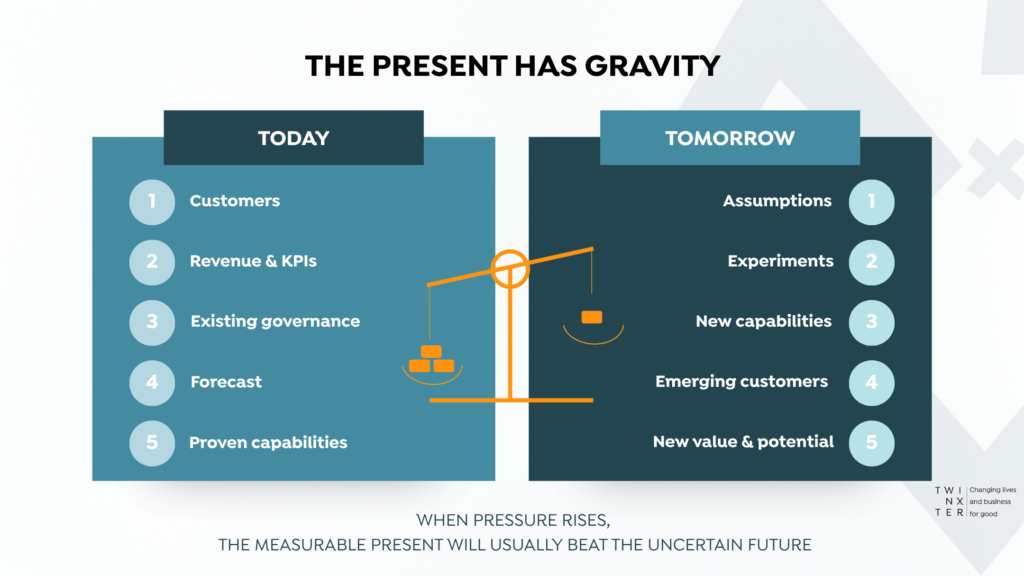
During this transition period, two organisational realities have to coexist. The first one is familiar and reasonably predictable. It contains your customers, budgets, processes, KPIs and a history of performance behind it. Employees know how this reality works, which decisions matter, and what they are expected to deliver.
The second reality will most likely not only involve a new customer proposition. It will probably also involve a different way of creating value altogether. Think in terms of different technologies, new partners, skills, or another revenue model. Some parts may be clear at start, but its likely that many assumptions still need testing.
That creates an immediate internal imbalance. Your existing business focusses on customers, revenue, margins and forecasts. While your emerging business usually deals with things like experiments, assumptions and early indicators. If both are competing for time, money and attention, it is not difficult to see which one will generally prevail.
The following I see happen quite often in organisations I work for. Leaders genuinely believe the future is strategically important, while most of their business system continues to reward the present status quo. I see budgets that favour proven activities, objectives that remain focused on current performance, and investment decisions that are made using the logic of the existing model. As soon as pressure increases, the future becomes remarkably easy to postpone. Does this tensions sound familiar to you as well?
The pull of the present
This is one reason why I do not think reinvention is mainly about convincing people to change. In many cases, people are behaving exactly as your system encourages them to behave.
Imagine that you tell your teams they have to experiment more, but every failed experiment still has to be explained upwards. Or you want decisions to move closer to customers while most authority remains several levels higher. Perhaps you say collaboration across departments is critical, while budgets, targets and accountability remain firmly inside functional boundaries.
None of those things may look problematic on their own. Together, however, they create a system that keeps pulling your people back towards the way your organisation already works. That is also why I think we sometimes tend to label behaviour as resistance far too quickly. People may simply be responding rationally to the targets, incentives and processes that are still in place. They just don’t know any better than that. So lets not label or worse, punish them for it.
Keep your business running
Organisations simply can’t stop their existing business while they reinvent it. Your current model still serves customers, generates revenue and employs people. In many cases, it will also finance a large part of the future you are trying to build. I have worked in several environments where we used the phrase Transform While You Run, and I still think it describes this pressure cooker rather well. I even wrote a whole case study on this subject which you can read here.
The real challenge is not choosing between today and tomorrow. You have to manage both for quite some time. And this becomes increasingly difficult when pressure grows over time. Things like customer issues that start popping up, or a project that is delayed or is unexpectedly over budget. Employees who were supposed to spend time exploring your future are then pulled back into your current business. Obviously, this makes sense from an operational point of view.
The problem grows when that happens time and time again. If your aspired future is always the first thing to lose capacity, it may look important on paper but it never gets the space to become reality. This is why reinvention needs real organisational space. For instance, your employees need time to work on new questions. And your leaders need to protect experiments long enough to learn from them while new capabilities need space to develop. But perhaps most difficult of all, something somewhere has to stop. And that’s going to hurt as saying goodbye to something is always painful.
Otherwise, your old priorities remain while new ones are added alongside them. Managers then have to translate both into something workable. At the same time, teams are expected to keep delivering, experiment, learn and build new capabilities. If you keep everything you already do in place, reinvention does not necessarily create more ambition. More often, it simply creates more work.
Learn while moving
When you optimise something, you normally have a reasonably clear idea of what ‘better’ looks like. You want a process to become faster, quality to improve, costs to drop or productivity to increase. You may not know every step you have to take to get there, but the destination itself is usually fairly clear.
This kind of change is less predictable because part of the work is discovering whether your assumptions about the future are actually correct. Some of your ideas will work and others will not. Other assumptions might differ as well. Think of customers that respond differently than expected or a capability you originally saw as secondary may suddenly become essential. It can also be that new technology causes the new model to move faster than anticipated.
I know from experience that that is not always an easy story to tell when a business case has already promised a certain outcome. But if every experiment has to deliver the answer you expect, there is not much experimenting or subsequent learning going on.
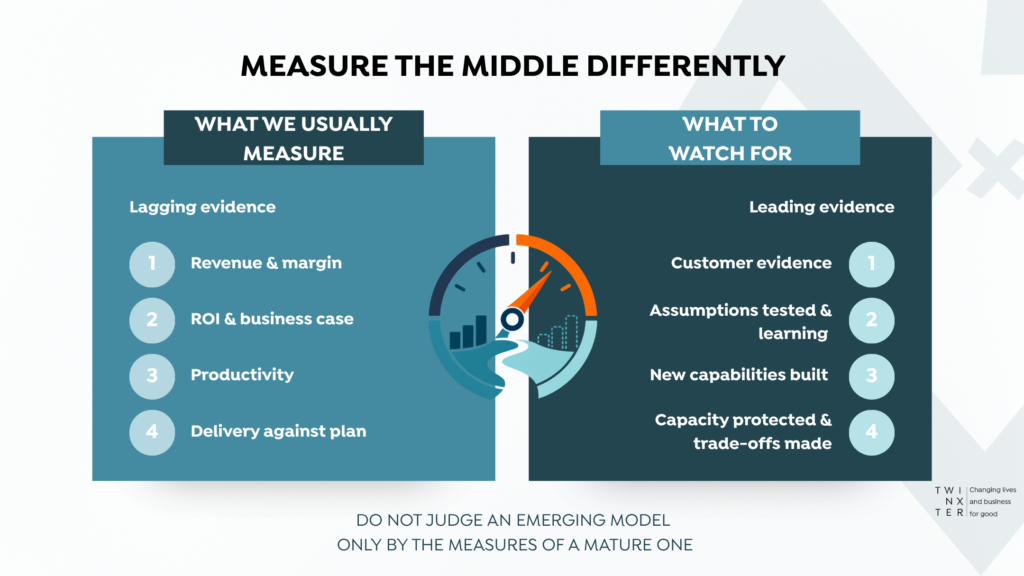
That is why leaders need to ask slightly different questions during this period. Of course, you still need to understand performance and investment, but you also need to know what you are learning. Which assumptions are becoming stronger? Which are weakening? What are customers telling us? And what should you change as a result?
Progress will not necessarily be equally visible everywhere either. One team may adapt quickly and visibly. Another may still depend heavily on the existing model. One experiment may produce something tangible while another probably leads nowhere. And that can feel messy. Especially for organisations that are used to clear milestones, nice status reports and roadmaps where progress is expected to follow a straight line.
It also a matter of perspective. Discovering that an assumption was wrong before investing another two years in it can also be considered progress. The challenge is more about making that learning visible enough so it’s not automatically interpreted as poor execution.
Build capability
For this reason the capability part is particularly of interest. Before the financial benefits become visible, organisations have to build capabilities that support their new model.
That sounds obvious, but I still see capability building treated as something that comes after a future organisation has been designed. First, a new model is created, then the structure is changed, and somewhere along the rainbow a conversation starts about what people need to learn. I would not separate those things so neatly.
If your future model requires capabilities you do not currently have, then building them is part of creating that new model. Your organisation may need to become much better at working with new skillsets. Think about new data-streams, experimenting with customers, managing ecosystems, using AI, developing products, or making low-level decisions.
Leadership capability may have to change as well. A leader who has been successful through control, expertise and escalation may suddenly be expected to give teams more freedom and autonomy.
People therefore need opportunities to practise those capabilities while your future is still emerging. They need to work on real problems, receive feedback and adapt accordingly. At the same time, your organisation has to remove some of the conditions that make new behaviour unnecessarily difficult. The standard method of training people to work differently while your system continues to reward old behaviour rarely produces much change. Surprised?
Make tension visible
This brings me back to visibility. Because visibility becomes especially important during the uncomfortable middle.Your current business still has to perform, while future opportunities are explored and new capabilities are developed. This means that associated investments have to move between these two realities. If those conversations take place in isolation, every part of your organisation can make a relative sensible decision while at the same time your overall system loses direction all together
To give you an example. Finance protects the business case. Operations protects the delivery. Technology protects the tech related platforms. HR focuses on capability. Each perspective makes sense on its own, but reinvention sits across all of them.
That is why I would make your system more explicit and visible. What are we protecting today, and what are we deliberately building for tomorrow? Where is our capacity actually going? Which assumptions are we testing? What are we learning? And where is current pressure consuming future investment?
This is also one of the places where Obeya can add a lot of value. It creates one shared space where your current performance, future priorities, experiments, risks, blockers, capabilities and decisions can be seen together.
That does not mean putting everything on a wall and expecting alignment to appear by itself. That’s not how an Obeya works. The value comes from looking at the same reality together. It entails questioning what you see, and making the trade-offs visible enough so they can actually be discussed.
What helps
There is obviously no standard formula for getting through this period. Every organisation is unique and so are the solutions. Every organisation starts from a different position and faces different pressures. The balance between today and tomorrow will never look exactly the same for everybody.
There are, however, a few things I would keep an eye on:
- Make today’s performance and tomorrow’s investment visible at the same time.
- Create genuine capacity for reinvention instead of adding it to an already full portfolio.
- Give experiments enough time to answer the question they were designed to test.
- Build new capabilities through real work rather than waiting until your future model is fully designed.
- Start deciding what receives less investment, because your organisation can’t keep everything forever.
That last one may be the most uncomfortable. Most organisations find it easier to add something new than to decide what to stop. But if very little is ever removed, reinvention becomes increasingly expensive and difficult to sustain. Definitely a situation you want to prevent from happening.
When discomfort looks like failure
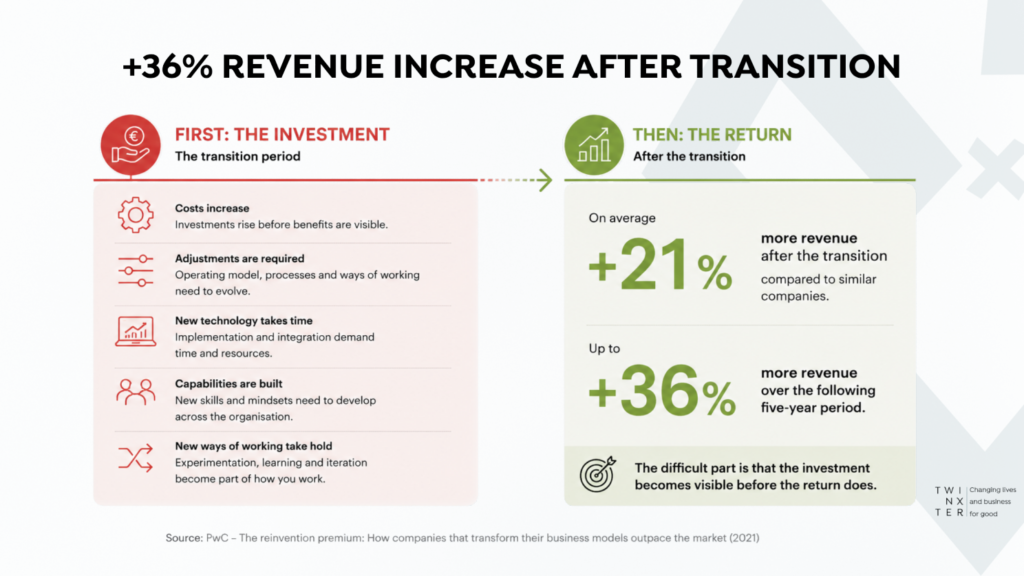
There is one final reason why I think the middle deserves more attention. It can look remarkably similar to failure. Costs may rise before benefits become visible. People are learning and are therefore not immediately as efficient as they were doing familiar work. No doubt that some experiments will fail or duplicate capabilities exist for a period. This means your organisation will have to carry both old and new systems at the same time.
For anyone looking primarily at immediate ROI, that can be a difficult picture. I recognise that from conversations with CFOs as well. Their questions are completely understandable and valit, because investment eventually has to create value. But the timing of that value matters.
This is exactly what made the research interesting to me in the first place. The financial benefit comes after the transition period and not before it. Your organisation first has to adapt and build the capabilities that allows your new model to perform.
That unfortunately also means that not every difficult transition eventually succeeds. Sometimes an experiment genuinely tells you that the direction is wrong, and then you should act on that information. But sometimes the discomfort is simply part of becoming capable of something new. It is up to the leadership team to understand the difference.
Stay in the middle long enough
Perhaps staying in the middle long enough is the biggest challenge of all. You need enough urgency to start reinventing before your current model becomes obsolete. At the same time, you should also have enough patience to let the new one develop properly.
You have to keep today’s business healthy without allowing it to consume all of tomorrow’s capacity. You need direction without pretending every answer is already known. And you need enough discipline to learn from what is happening rather than treating every deviation from the original plan as a problem.
That balance is not really comfortable, but I am also convinced it shouldn’t be. If your organisation is genuinely building something new, then there will be moments when the old and new do not fit together as you want them to. What matters is whether this is visible enough and whether you are making deliberate choices about them.
If you recognise this situation in your own organisation, I would be happy to start this conversation with you. Especially when your challenge is not simply defining a new direction, but also keeping today’s business moving ahead while creating enough room for something different to emerge. So reach out and let’s connect.
In the final part of this series, I want to move one step further. Because once your future business model starts becoming clearer, another question becomes difficult to avoid: can the organisation you have today actually run it?
That takes us into operating models, governance, leadership, capabilities and ways of working. In other words, into what needs to change inside your organisation when the business itself begins to change. Looking forward to meeting you there.
If these insights have helped you see your organisation more clearly, and you want to explore what that could mean in practice, let’s have that conversation. Book a 30-minute call for an honest exchange about where leadership is working well, and where your design may be getting in the way.
Book your complementary call here https://www.twinxter.com/contact/

