
One thing that really stands out to me about the latest AI trend is how fast the discussion gets boxed in. You read or hear of a new capability that is being used or announced, and within moments the focus turns to productivity, headcount, and cost. How much faster can we work? What can we automate? How much labour can be reduced? WOW, is that all that makes us and AI tick? At one level, it is all very understandable. AI is already changing the economics of work, and it would be strange if leaders were not asking what that means for efficiency. OK, strike one.
But the more I watch how organisations react to these new capabilities, the more I believe many aren’t looking at this challenge broadly enough. AI is not only raising a cost question. It is definitely also raising an organisational one.
That is what I want to go over in this newsletter. Because I really do not believe the most important question is whether organisations can cut enough jobs or automate enough tasks to improve the next quarter. Do you? Really?
To me, the more fundamental question is whether organisations are willing to rethink their own blueprint. This means looking at work design, how people interact with technology, and how decisions are made. It also involves seeing how structure impacts progress and how the operating model needs to change as human work evolves.
That is a very different conversation from a simple cost-reduction perspective, and in my view, it is a much more useful one.
The automation instinct seems understandable
Many organisations are approaching AI with a logic most are familiar with. New technology arrives, so the immediate focus goes to efficiency. You can imagine leaders and managers starting to glow already: how can we reduce manual effort, speed up routine work, cut waste, and lower costs? Yes, let’s go!
I get it. These are not irrational aims, and in some cases, they will produce very real gains. The risk begins when this becomes your whole strategy. I see that once AI is treated mainly as a replacement mechanism, organisations tend to underplay everything else that changes alongside it. Think about roles and expectations that shift. Or the balance between decision-making and execution that starts to shift. Coordination changes. Leadership work changes. Management work changes. Team boundaries become more flexible. New dependencies appear. Old decision structures become too slow. And work itself starts to look different, even when the job title has not changed. Funny, isn’t it?
That is why I would be careful with any AI strategy that begins and ends with labour reduction. Your company can automate tasks and still fail to become stronger. Sure, it can reduce costs but, at the same time, still weaken trust. It can even speed up output and yet still leave people unclear about what now matters most. And in some cases, it can make an organisation more fragile. Short-term efficiency may come at the cost of learning, motivation, decision-making, or adaptability. That is not a technological failure. It is a strategic mistake.
Harvard Business Review (HBR) sharpened this point well back in April. In Why Companies That Choose AI Augmentation Over Automation May Win in the Long Run the authors say leaders face a key choice with AI. They can either boost profits by automating and cutting jobs, or aim for lasting value through augmentation. Their research shows that employees who see augmentation intent engage more with AI. They collaborate better and are less likely to leave than those who see automation intent. In other words, the choice shapes behaviour as much as economics.
The real choice
That HBR argument is useful I think. But I also still think the public conversation often presents a form of false simplicity. It sounds as if the question is whether AI will replace people or help them. For me, that is still looking at things from a narrow perspective. A better distinction is between organisations that link AI to their current model and those that use AI to reshape the model itself.
In the first case, AI is added as a productivity layer. It helps you speed up selected tasks, support certain functions, reduce manual work, and deliver efficiency gains. The underlying organisation remains largely the same. Your structure, coordination logic, operating rhythm, decision model, and role architecture stay mostly intact.
In the second case, it becomes more dynamic. AI becomes a trigger for redesign. Leaders start asking different questions. If this work can now be done faster or differently, what should the human role become? If AI can analyse, draft, route, or recommend, how should decisions move? If teams have more technological support, what needs to change in the way they are coordinated? If people are no longer valued mainly for repetitive execution, what becomes more valuable instead? That is the shift I find far more interesting. It turns AI from a cost mechanism into an organisational blueprint question.
McKinsey’s recent Superagency in the Workplace actually also points in that direction. Its main message is not that companies lack tools. Instead, many struggle with leadership follow-through and organisational change. Almost all companies are investing in AI. However, only 1% think they have got some form of maturity. McKinsey says the biggest barrier to growth is not employee readiness. Instead, it’s leaders who aren’t acting quickly enough and organisations that aren’t adapting to this change.
Blueprints matter more than tools
What often surprises me is that many organisations are still talking about AI as if it were mainly a tool choice. Which platform, which use case, which pilot, which workflow, which savings. Those are real questions and all fair on their own. But believe me when I say that they are not the ones that will decide who builds stronger organisations over time.
The real gains will not come from the tool alone. They will come from what the tool forces you to rethink. If AI changes the shape of work, then your operating model needs to change as well. The same goes for workflows that require a redesign. Or role boundaries that need a review. Governance that has to become clearer. Decision rights that have to match the new pace. And middle management cannot simply become an even more overloaded translation layer (see also my article on When managers become shock absorbers). And your teams won’t just adapt to new technology unless they rethink how they manage priorities, ownership, and rhythm.
This is why I do not see AI as a standalone change topic. I see it as something that is highlighting the limits of the current organisational model much faster than many leaders expected. In some organisations, AI will reveal that the real impediment was never the task itself, but the approval chain around it. In others, it will highlight that people are working harder, but they are still held back by unclear priorities and decision delays. And in others again, it will highlight that management was already too stressed to work faster without a proper redesign.
To highlight yet another recent great article, Boston Consulting Group (BCG) really drives home this point as well. In Design Your Company for AI, Not AI for Your Company, they argue that many companies are trying to fit AI into old structures when what is really needed is the opposite. AI should be a reason to redesign the company itself, not simply another tool that the old organisation is expected to absorb. What do you know, just like I mentioned before. BCG also says AI is changing jobs faster than companies can adapt. So, having a clear strategy will become increasingly important as this happens.
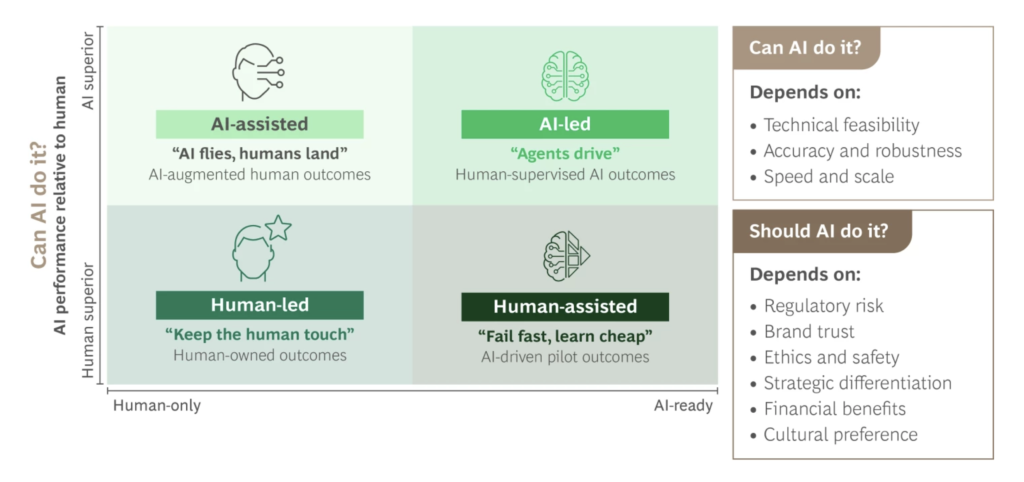
This is where things get more interesting. The question is then not only whether AI can do something, but whether it should, and what that means for the way your organisation works.
Treating people as variable cost
There is another reason the job-cutting perspective is not broad enough. It trains organisations to see people as something to optimise, not as a capability to redesign around. That may sound efficient in the short term, but it can become expensive very quickly in the longer term.
When employees believe AI is mainly being introduced to replace them, that will shape their behaviour. It will start to affect organisational trust, their willingness to experiment, openness to learning, and the quality of adoption. Why would they put any effort or faith into something that will replace them?
People engage with new tools in the emotional and strategic context created by their leaders. If your message suggests that AI will take away value from human work, don’t be surprised if people react with caution, politics, protection, or disengagement. That is not resistance to technology. It is a rational response to a perceived threat.
And please note that the stronger alternative is not naïve optimism. It really is honesty combined with redesign. If AI is going to reshape work, just say so. It will earn you trust and credit. If some tasks will disappear, be honest about that too. Combine that conversation with a serious discussion about where human contributions are most valuable. Consider how work will change, what new expectations are coming, and how the organisation plans to help people adapt to that future. That is a very different leadership stance from simple cost-cutting.
What augmentation gets right
This is where the perspective of augmentation becomes useful as a strategic orientation. Augmentation starts from a different premise. It asks how AI can expand what people are able to do, not only what it allows your organisation to remove. It treats human capability as something to strengthen and redesign around. It assumes that decision-making, creativity, and connection will be more important. So will interpretation, sense-making, and decision quality. These skills will matter more as AI takes over routine and generative tasks.
That does not mean augmentation is soft. In many ways, it is harder. It asks more from leaders. They need to make choices about their operating model, the redesign of roles, investments in learning, and clearly define where humans add value now. I believe this is a more serious long-term strategy. Organisations don’t succeed by just automating without a clear plan. They win by building a stronger performance system.
Such a system still depends on whether your people trust the direction. They have to really understand their roles and make good decisions together, and learn at the right pace. It’s also important that they understand how their work contributes while operating in a changing environment. AI may change the mix of work. It does not remove the need for that foundation.
In a final piece I want to refer to, BCG makes a similar point in AI Transformation Is a Workforce Transformation. The companies that realise more value are not simply buying better tools. They redesign workforce models, governance, and operating structures around human-AI collaboration. In other words, the real move here is not about substitution alone. It is in the mix of things.
Structure and operating model
If we want to take this more seriously, then the conversation has to move beyond tooling and into organisational design. That means looking at structure first.
- Are roles in your organisation still built around work that no longer needs to be done in the same way?
- Are managers expected to handle more tech changes without a real rethink of management?
- Are support functions getting ready for AI mainly with pilots?
- Or are they also rethinking their roles, process design and decision flow?
The same thing applies to your operating rhythm. If AI increases the speed of your output, then you also need to manage priorities, trade-offs, and decision-making in a new way. You can definitely produce more work in less time. However, that doesn’t mean your organisation can handle it better. Leaders therefore need to consider more than just the tool. They should also look at what becomes visible, what still gets stuck, and where the old rhythm of your organisation can’t keep up with the new pace.
And not to forget, governance becomes just as important. If your AI solution boosts information, recommendations, and analysis for your teams, then decision rights must align with this change. Your organisation can’t expect to move faster if it keeps being vague around ownership, high escalation, and fragmented flows. That is why I see AI not mainly as a workforce reduction story, but as a question about the shape of your organisation itself. For sure, jobs will change. There is no doubt about that. But the larger opportunity lies in how work is redesigned and how your operating model evolves around that.
What you should ask now
This is also why I think leaders need a better set of questions than the ones dominating much of the current AI conversation. The most useful questions are not only technical. They are strategic and organisational. For me, a serious leadership conversation should include at least the following ones:
- Are we using AI mainly to save labour, or to redesign work more efficiently?
- Are we clear about where human decision-making becomes more valuable, not less?
- Are we genuinely redesigning roles and workflows, or simply placing the AI onto existing complexity?
- Are we preparing managers for the additional coordination load this may create?
- Are we treating AI as a technological rollout, or as a prompt to rethink our operating model?
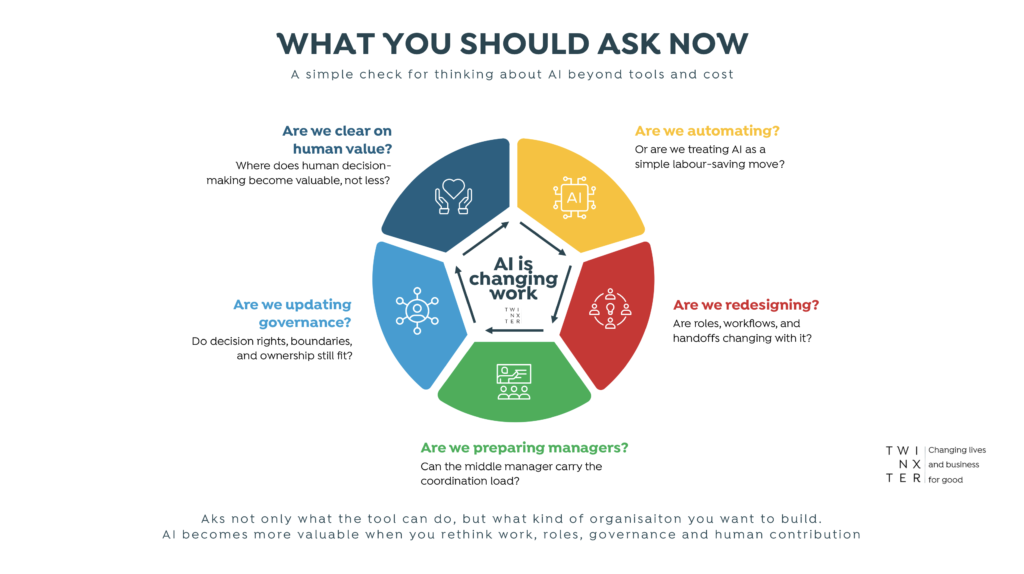
These questions are really important as they force your organisation to make real choices. The issue is not simply whether to adopt AI. The issue is what kind of organisation is being created through that adoption. If you don’t ask that question directly, you might still improve speed and efficiency if that is what you are looking for. However, you will probably also miss the opportunity to enhance how your organisation truly operates.
A better path forward
Your AI strategy starts to look different once you take that broader organisational question more seriously. Once going down this route, it presents itself with some great benefits:
- It treats work redesign as seriously as tool adoption.
- It clarifies where human contribution in your organisation becomes more valuable.
- It changes governance, structure, and rhythm. It doesn’t just expect the old organisation to absorb the new technology.
- It offers your people a realistic future during the change, instead of making them trust a process that seems focused on diminishing them.
This way, the long-term value of AI will not come simply from replacing people at scale. It will come from creating better mixes of human skills, machine abilities, and clear organisation. In other words, your main challenge isn’t how fast AI can be introduced. It’s whether your organisation is ready to change because of it.
The crux of the matter
So, the real AI question is therefore not only what can be automated right now. It is what kind of organisation you are trying to become because of it. It is indeed a much harder, slower, and more strategic question, but it is also the one that is truly important.
If you treat AI mainly as a cost-cutting programme, your organisation may well find gains. What they may not find is a stronger, clearer, and more adaptive organisation on the other side of it. If your AI solution makes you rethink work, then that’s a big deal. It can change decision-making, structure, leadership, and coordination. This opens up even larger opportunities. What you gain is no longer only focused on more output, but also on a better operating model.
That is the conversation I believe you need to start having now. And if you want to explore this more deeply, my work at Twinxter can help. This is especially true when the challenge isn’t the technology itself, but rather the human-centred redesign needed to make AI a true organisational advantage.
If these insights have helped you see your organisation more clearly, and you want to explore what that could mean in practice, let’s have that conversation. Book a 30-minute call for an honest exchange about where leadership is working well, and where your design may be getting in the way.
Book your complementary call here https://www.twinxter.com/contact/

